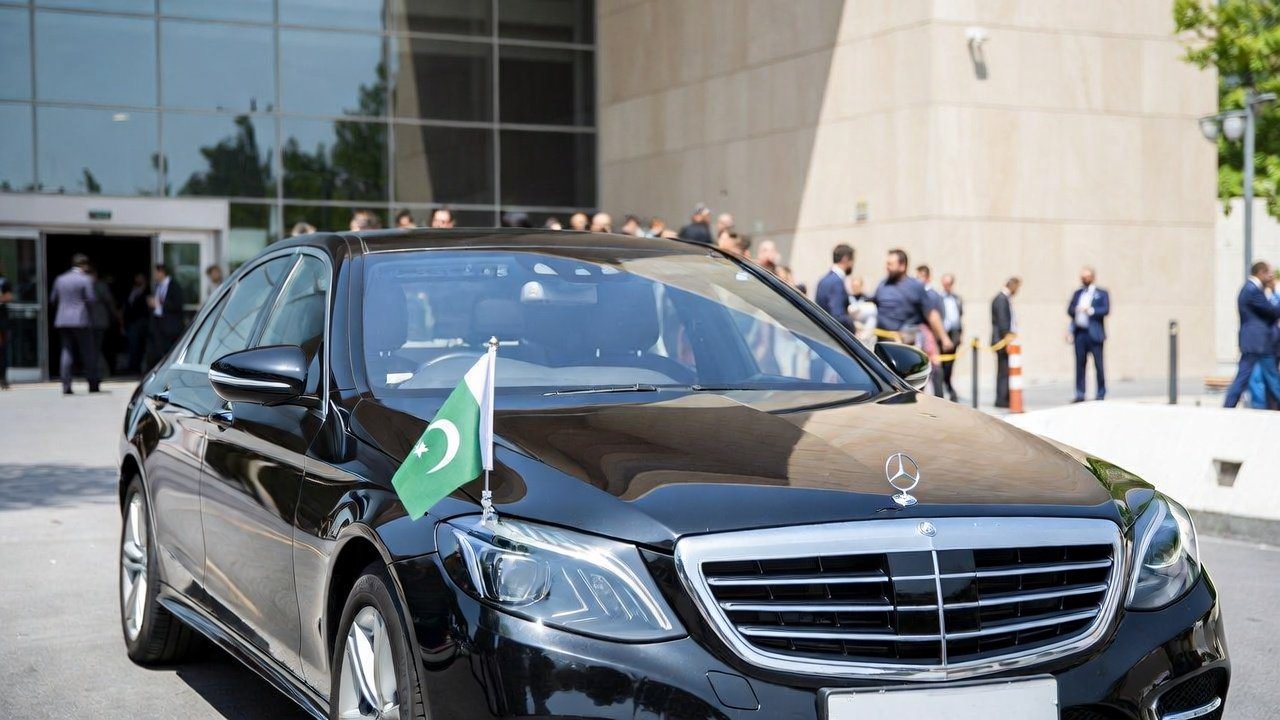
Shehbaz Sharif lands in New York on 21 September and addresses the General Assembly on 25 September, fourth speaker in the afternoon sitting on the provisional speakers' list. Ishaq Dar left Islamabad on 20 September to prepare the ground. The delegation has been cut back under the government's own austerity rules. Dar and the foreign-policy adviser Tariq Fatemi form its core, and the information, climate change and planning ministers who had been expected to travel were dropped. The Cabinet Division notification of 17 September bans official foreign travel for three months, obligatory visits included, and says ambassadors will represent Pakistan at events that cannot be missed. Field Marshal Asim Munir is not reported as part of the delegation.
Donald Trump speaks on 22 September and Masoud Pezeshkian on 23 September, after the State Department admitted Iran's core delegation under host-country obligations with travel restrictions attached. Sharif is invited to a reception Trump is hosting at the Lotte New York Palace on 23 September. The News, citing high-level sources, has reported a Sharif-Trump meeting around it; neither government has confirmed one. Trump is also due to meet Gulf leaders in New York during the week while weighing whether to resume strikes on Iran. S. Jaishankar speaks for India on 26 September. The general debate runs from 22 to 28 September under Bangladesh's foreign minister Khalilur Rahman, who presides over a session themed "Restoring Trust, Managing Transformation: A United Nations That Delivers for All." It is António Guterres's last high-level week, and the third straw poll for his successor on 18 September produced no consensus candidate.
Pakistan arrives with more diplomatic standing than at any point in recent years, and with constraints at home that limit how much of it can be used. Iran's foreign ministry calls it the mediator between Tehran and Washington. It sits on the Security Council until 31 December. It holds a unanimous arbitral award on the Indus that India has declared void. It also carries:
- roughly 8,000 troops in Saudi Arabia and a trilateral defence pact that nobody has invoked;
- 23 dead in Kohat from an attack on 18 September;
- petrol at Rs391.22 a litre after an eighth consecutive rise;
- a protest march converging on Islamabad;
- an IMF mission arriving on 23 September.
Eight Thousand Troops And No Request
Pakistan already has a combat-capable force in Saudi Arabia. Reuters reported on 18 May, from three security officials and two government sources, that Pakistan had sent about 8,000 troops to the kingdom with a pledge of more if needed. The force includes a squadron of roughly 16 JF-17s that arrived in early April, two squadrons of drones and a Chinese HQ-9 air defence system. Pakistani personnel operate the equipment and Saudi Arabia pays for it. The deployment falls under the bilateral Strategic Mutual Defence Agreement of 17 September 2025. One government source who had read its confidential text said it allows for up to 80,000 Pakistani troops to help secure the kingdom's borders. Two security officials said warships were covered too, though Reuters could not establish whether any had arrived. Neither government commented.
The trilateral agreement was signed in Mecca on 7 August, at Al-Safa Palace, by Mohammed bin Salman, Recep Tayyip Erdogan and Shehbaz Sharif. The Foreign Office calls it the Makkah Joint Defence Agreement; English-language reporting mostly calls it the Mecca pact. Its text is unpublished. It treats an attack on one as an attack on all three. Turkey's defence ministry has likened it to NATO's Article 5, with political and military mechanisms planned at the level of defence ministers, foreign ministers and chiefs of staff. The three foreign ministers held the first committee meeting under the agreement in Istanbul on 31 August. There they named it the Mecca Defence Alliance, set up a secretariat in Riyadh and said its first secretary-general would be Pakistani. Hakan Fidan has described the mechanism as working like NATO's collective-defence clause, with the attacked state making the request.
It is not yet in force in any practical sense. A Turkish official said that Ankara has not submitted the agreement to parliament and may not do so before October. Pakistan must complete its own internal approval, while Saudi Arabia can ratify by royal decree. Joint defence plans, rules of operation and coordination mechanisms do not yet exist. "This may take several years," the official said. Even in force, activation would need a formal Saudi request followed by consultations among the three.
The attacks have escalated since the signing. The Houthi campaign against Saudi Arabia resumed in July:
- 8 September: missiles and drones hit Abha, Khamis Mushait, Jazan and Najran, starting fires at oil facilities and injuring 73 people, according to coalition spokesman Major General Turki al-Malki. The Houthis said Saudi warplanes carried out 54 strikes across Yemen in the following 12 hours.
- 11 September: the East-West Pipeline to the Red Sea was shut after drone attacks the previous day, which Riyadh attributed to militias in Iraq.
- 13 September: a projectile wounded two people and damaged a mosque in Jazan's al-Tuwal governorate.
- 15 September: at about 6:50pm, according to Riyadh, Saudi air defences destroyed a Houthi drone south of Makkah before it entered the city's airspace. Al-Malki called the holy sites a red line and described it as the second attempt on the city since a ballistic missile in July 2017. The Houthis denied targeting the city, and Abdel-Malik al-Houthi called the claim a heinous lie on 17 September.
- 17–18 September: a drone was reported over Taif on 17 September, and an Italian Eurofighter was damaged at King Fahd Air Base in Taif overnight.
- 18 September: the Security Council, with Pakistan at the table, condemned continued Houthi attacks on the kingdom in the strongest terms.
- 19 September: Riyadh received its first air-raid alerts since July, smoke rose from the fuel storage area at King Khalid International Airport, and the Houthis claimed missile and drone attacks on sensitive sites in the capital.
Riyadh has also asked for help outside the pact. Two regional officials told the Associated Press on 16 September that Saudi Arabia, running low on interceptors, had asked France, Britain, Pakistan and Egypt to deploy air-defence support. Turkish and Pakistani officials told the AP, anonymously, that no Saudi request had arrived under the trilateral pact, and a Turkish official said the alliance had to be institutionalised first. On the AP's reporting, the request to Pakistan therefore came outside the Makkah agreement.
The only trilateral military coordination on the public record came early. After the 8 September attacks, a Pakistani source told Reuters that Saudi officials had met senior Pakistani and Turkish military representatives in Riyadh. The three agreed that none of their troops would enter Yemen and that any retaliation would be launched from Saudi territory. A second Pakistani source said no decision had been taken to join. Türkiye Today reported on 9 September, citing Pakistani sources, that strikes on Houthi positions including Saadah were under consideration if a request came. Whether Pakistani personnel or equipment already in the kingdom have been used in Saudi strikes on Yemen is unconfirmed.
Pakistan's statements have come thick and in two registers:
- After the 8 September attacks the Foreign Office called them a flagrant violation of Saudi sovereignty and backed Riyadh's legitimate right to defend itself, and Sharif called them cowardly.
- Asif told Pakistani television the same week that aggression on one country would count as aggression on all three, and that spillover into Saudi Arabia "will definitely make this agreement operational."
- On 10 September spokesman Sajjad Haider Khan said Pakistan would play its role "in accordance with the requirements of the agreement". He called the pact purely defence-related and built on deterrence, and said no military response was under discussion.
- Dar condemned the attempt on Makkah "in the strongest possible terms" on 16 September.
- The same day the Director-General of ISPR, Lieutenant-General Ahmed Sharif Chaudhry, told Al Arabiya the pact was "collective deterrence" with no regional aspirations. The following day he told Arab News that Pakistan would defend the kingdom to any extent, repeating the word physically, and that Pakistani forces were already there protecting the two holy sites.
- Asif said on 17 September that "the Mecca agreement applies to us, and we will fulfil our duty," and that "if Makkah is attacked, there is no need for an agreement to protect it."
- On 19 September Religious Affairs Minister Sardar Muhammad Yousuf told Arab News that implementation was already taking place.
Ministers who say implementation is under way appear to mean the bilateral deployment. Officials who say nothing is under discussion appear to mean the trilateral pact and offensive action outside Saudi territory. That reading is the Playbook's, and no official has drawn the distinction in public. The precedent Islamabad reaches for when pressed is the parliamentary resolution of 10 April 2015, moved by Ishaq Dar. It asked that Pakistan stay neutral in Yemen while affirming that it would stand "shoulder to shoulder" with Saudi Arabia if its territorial integrity or the holy sites were threatened. That resolution was not binding on the executive and predates both agreements.
Talking To Tehran
Mediation is the file the delegation will most want to discuss. Pakistan brokered the two-week ceasefire that took effect on 8 April and that Trump extended indefinitely on 21 April. It hosted the first round of direct US-Iran talks at the Serena Hotel in Islamabad on 11 and 12 April. They failed, and Washington imposed a naval blockade the next day. Ahmad told PassBlue the Islamabad round was the highest-level engagement between the two in more than four decades.
The Islamabad Memorandum followed in June. The Foreign Office dates its signing to 17 June; some reports put it a day later. Trump and Pezeshkian signed for their governments, and Sharif signed as mediator. The Foreign Office describes Pakistan's role as guarantor. Sharif then led Pakistan's delegation to Bürgenstock, accompanied by Munir, for the first formal session under the memorandum on 21 June. JD Vance led the US delegation and parliament speaker Mohammad Bagher Ghalibaf led Iran's, with Pakistan and Qatar as mediators. The session produced a roadmap toward a final agreement within 60 days.
Trump declared the ceasefire over on 8 July after fresh exchanges of fire. As the 60-day window closed, Pakistani sources said both sides had agreed in principle to extend it, while Interior Minister Mohsin Naqvi held talks with Abbas Araghchi in Mashhad. Araghchi said on 15 August that the 60 days had been a negotiating window, that fighting had already resumed, and that exchanges through mediators were not a return to talks. The memorandum lapsed on 17 August.
The channel survived all of that:
- 4 August: Iran's foreign ministry spokesman Esmail Baqaei said the mediator between Iran and the US "is Pakistan, and Qatar also helps in cases where necessary."
- 24 August: Munir met Pezeshkian in Tehran.
- 28 August: Mohsen Rezaei, secretary of the Supreme National Security Council, set out Iran's conditions: an end to the regional war, lifting of the blockade on Iranian ports, compensation and sanctions relief. He said they had been compiled in response to requests from mediators.
- After the 8 September attacks: Pakistan delivered a Saudi warning to Tehran to rein in the Houthis. A senior Iranian official confirmed receiving it and replied that "Iran does not control the Houthis."
- 18 September: the Financial Times reported that Munir has been in frequent contact with Iranian officials including Araghchi, pressing Tehran to get the Houthis to stop attacks on Saudi territory. Reuters reported a call between the two on Houthi attacks and a return to talks.
- 19 September: Rezaei said Tehran had passed its conditions to the Qatari and Pakistani mediators and was waiting for Trump's response.
With Pezeshkian and Araghchi in New York and Trump in the same building, Dawn's UN correspondent reads the session as another opening for those contacts.
The Reuters report that carried Pakistan's warning also quoted two Iranian sources saying Tehran had told the Houthis to carry out attacks on Saudi Arabia, which Iran's official line denies. Pakistan is lobbying Tehran to restrain a group that it has separately undertaken to treat as an aggressor if it strikes Saudi Arabia. Its standing as a go-between is contested on both sides. The Iranian lawmaker Ebrahim Rezaei said in April that Pakistan lacked the credibility to mediate. In Washington, Senator Lindsey Graham questioned its credibility after Pakistan declined the Abraham Accords. The Playbook's view is that the Munir-Araghchi channel is worth more to Riyadh than a Pakistani airstrike would be. That is untested, and the Houthis have objectives in Yemen that Iranian pressure may not reach.
A Seat, Not A Contribution
Pakistan announced on 21 January that it would join the Board of Peace, and was one of 14 countries that signed its charter at Davos on 22 January. The Foreign Office presents membership as part of a collective effort by eight Arab and Islamic states under Security Council Resolution 2803: Pakistan, Saudi Arabia, Turkey, Egypt, Jordan, the UAE, Indonesia and Qatar. Netanyahu accepted membership on 21 January after objecting to the presence of Fidan and Qatar's Ali Al-Thawadi on the Gaza Executive Board, which also seats Tony Blair and Jared Kushner. The charter itself does not mention Gaza.
At the Board's inaugural meeting in Washington on 19 February the stabilisation force took shape. Major General Jasper Jeffers, its commander, announced that Indonesia, Morocco, Kazakhstan, Kosovo and Albania had committed troops and that Egypt and Jordan would train police. The force would deploy sector by sector from Rafah toward a long-term target of 20,000 soldiers and 12,000 police. Indonesia took the deputy command with an offer of up to 8,000 troops. Fidan pledged Turkish troops from the floor. Delegations from 47 countries attended. Gulf and Central Asian states pledged more than $7 billion, and Trump pledged $10 billion.
Pakistan's delegation, led by Sharif, made no troop pledge. The same day Foreign Office spokesman Tahir Andrabi said Pakistan was waiting for the contours of the force's mandate before deciding, and set out the line: "Pakistan can be part of a peacekeeping mandate, but we would not be part of any disarming/demilitarisation mandates." Dar had put it more bluntly in November 2025, saying disarming Hamas was not Pakistan's job. Andrabi had said on 29 January that the decision to join the Board was taken "in good faith", and that no decision had been made on the stabilisation force.
No later commitment has been announced. A February survey found nearly three-quarters of Pakistanis would support a deployment, with 78 percent of men and 68 percent of women in favour. Seven months on, Pakistan remains a Board member with no contribution to the force the Board exists to field, while Indonesia, Morocco, Kazakhstan and Turkey are committed.
The civilian track has moved more slowly still. A National Committee for the Administration of Gaza, led by the former Palestinian minister Ali Shaath and based in Egypt, has not entered Gaza. Pakistan's permanent representative described the ceasefire on 15 September as incomplete, borrowing Guterres's phrase about a lesser fire. In New York, Dar is scheduled to attend two meetings on Palestine: the Group of Eight Arab and Islamic countries, and the ministerial of the Global Alliance for the Implementation of the Two-State Solution. Mahmoud Abbas will take part in the Assembly by video.
On normalisation the line has not moved. Trump posted on 25 May that he was "mandatorily requesting" that countries including Pakistan join the Abraham Accords, while acknowledging that some might have reasons not to. He said he had spoken with several regional leaders, including Munir, before posting. Asif said the next day that Pakistan should not join "any accord that clashes with our fundamental ideologies." The Foreign Office had already ruled out joining in January.
Water Under The Bridge
India placed the Indus Waters Treaty in abeyance on 23 April 2025, the day after the Pahalgam attack. On 31 August 2026 the Court of Arbitration issued an Award on the Status of the Treaty and an Order on Interim Measures in the Indus Waters Western Rivers Arbitration. The tribunal held unanimously that none of India's grounds justified suspension or termination, and that the treaty remains fully in force, including on hydroelectric projects on the Western Rivers. Its interim order bars concreting of the Ratle dam wall and power intake above specified levels on the 850 MW project on the Chenab. The bar runs until 90 days after the Neutral Expert's final decision, expected in July 2027. India was invited to take part and filed nothing, written or oral.
New Delhi rejected the award the same day. It called the tribunal an "illegally constituted so-called Court of Arbitration" set up by the World Bank in breach of the treaty, said the abeyance remains in force, and said "India has never appeared before this body." That has been India's answer to every step of this arbitration: the competence ruling of July 2023, the general interpretation awards of August and November 2025, and the pondage award of May 2026.
Pakistani reports citing sources say Sharif will raise the award on 25 September. What he intends to ask for is not clear from those reports. The World Bank appointed the tribunal and administers the treaty's dispute machinery, yet it has said nothing publicly about the 31 August award that the Playbook can find. It has also not been asked to, in any statement Pakistan has issued since.
The Word India Will Not Hear
Pakistan's Kashmir language is unchanged. Dar will attend the OIC Contact Group on Jammu and Kashmir during the week to restate what the Foreign Office calls support for the Kashmiri right to self-determination. Ahmad told PassBlue that the unresolved dispute over Indian-administered Jammu and Kashmir remains a threat to regional stability, the formulation Pakistan has used for years.
The audience is what shifted. The joint communiqué of the eighth EU-Pakistan Strategic Dialogue, held in Islamabad on 1 June and co-chaired by Kaja Kallas and Dar, recorded three things. The Pakistan side briefed on Jammu and Kashmir, the EU side briefed on Russia's war against Ukraine, and both supported peaceful resolution of conflicts in accordance with the UN Charter. India rejected the reference on 2 June, saying neither Pakistan nor the EU had locus standi on its internal matters. Set beside the fifth-round communiqué of 2021, in which Josep Borrell said the EU was following the human rights situation closely and called for resolution of the dispute, the 2026 text is procedurally thinner. That comparison is the Playbook's. New Delhi reacted to the weaker text more sharply, which indicates what India now counts as a loss.
Pakistan-administered Kashmir has had its own year of unrest over prices and governance, led by the Joint Awami Action Committee, and reliable reporting on its scale is thin.
The Neighbour Problem
The Kohat attack came a week before the speech. At about 1:20pm on Friday 18 September, during Friday prayers, an explosion hit the mosque inside Kohat's old Police Lines on Hangu Road. Attackers then stormed the compound, pushing toward the Counter Terrorism Department and Special Branch buildings, and one detonated near the Special Branch building. The clearance operation ran about 21 hours.
The official toll rose to 23 dead, 17 of them police, and official accounts put the injured at 103 or 130. KP Police said eight attackers were killed; Interior Minister Mohsin Naqvi said seven. Among the dead was Dr Israel Khan Orakzai, a paediatrics specialist at Liaqat Memorial Hospital.
The attack was claimed by Ittehad-ul-Mujahideen Pakistan, an alliance formed in April 2025 of the Hafiz Gul Bahadur Group, Harakat Inqilab-e-Islami Pakistan and Lashkar-e-Islam. It is led by the Afghanistan-based Hafiz Gul Bahadur. A roadside bomb had killed six soldiers in neighbouring Hangu the day before. Islamabad followed Kohat with a public demand that the Taliban authorities dismantle militant networks, Arab News reported.
In Balochistan, the military said on 20 September that it had killed five militants of what it calls Fitna al-Hindustan at an illegal checkpoint on the N-25 near Kalat, and had recovered 23 abductees. It had reported 12 militants killed in Kalat on 2 September and 11 in Kharan and Washuk on 6 and 7 September. Fitna al-Hindustan is the state's designation for Baloch groups it accuses India of backing.
The Afghan front has been an interstate war this year. Pakistani jets struck Afghan border areas on 22 February. After Afghan forces attacked Pakistani border posts, Pakistan hit Taliban targets in Kabul, Kandahar and Paktia on 27 February under Operation Ghazab Lil Haq. Asif said: "Now it is open war between us and you." Pakistan claimed 274 Taliban fighters killed; the Taliban claimed drone strikes into Pakistan. China hosted talks in April, and the resulting ceasefire was reported at risk by the end of that month. Qatar and Turkey had brokered the previous truce in Doha in October 2025.
The UN record on this is the strongest document Pakistan holds, and it is the one it uses least at the UN. The Monitoring Team's 38th report, S/2026/651, covers 16 December 2025 to 9 June 2026. It found that the Taliban authorities "continued their support to the TTP, which escalated attacks against Pakistan, provoking military exchanges", and that the steps Kabul had taken appeared aimed at managing the group short of dismantling it. It records growing links among the TTP, al-Qaeda, ISKP and the BLA, and Afghan national identity cards issued to the leadership of al-Qaeda in the Indian Subcontinent (AQIS).
The previous report of February 2026 listed what the TTP was fielding: assault rifles, night-vision, thermal imaging, sniper systems and drone attack systems. It said "most of these were provided by the de facto authorities, along with weapons licences and travel documents," and placed the AQIS emir and his deputy in Kabul. UN monitors also describe AQIS as providing training and strategy to Ittehad-ul-Mujahideen Pakistan, the group that claimed Kohat. No member state supported the Taliban's claim that no terrorist groups operate from Afghan soil. Pakistan has cited the 35th, 36th and 37th reports in its own submissions. It has not turned any of them into a Council product during its own term, which expires in 14 weeks.
Amir Khan Muttaqi visited India from 9 to 15 October 2025, the first visit by a Taliban minister, on a Security Council travel waiver. India upgraded its technical mission in Kabul to an embassy on 21 October. Four Taliban ministers visited India over the following nine months.
Running On Fumes
Pakistan imports more than 80 percent of its oil, and its oil bill between July 2025 and February 2026 was $10.71 billion. It is buying in the most expensive market in years. Brent settled near $104 a barrel on 17 September after the East-West Pipeline shutdown pushed it toward $108, and it has risen nearly 80 percent since January. Petrol rose to Rs391.22 a litre on 17 September, the eighth consecutive increase. The government raised the petroleum levy on petrol by Rs55 to Rs161 a litre in the spring, while the IMF refused to treat the levy as negotiable. JI now says the government collects Rs107 a litre, a figure the government has not confirmed.
The second austerity package of the year came the same day. The Cabinet Division notification:
- cut fuel for official vehicles by half for three months;
- banned purchases of vehicles and most durables;
- imposed a 5 percent cut in non-employee expenditure for 2026-27;
- banned official foreign travel for three months.
The package also bans official dinners and keeps the one-dish rule at weddings. A subsidy of Rs100 a litre for motorcycle, rickshaw and small-car owners began on 16 September.
Pakistan's climate pitch at the UN rests on its nationally determined contribution: a 50 percent emissions cut by 2030, of which 35 points depend on international finance. The climate change minister is among those dropped from the delegation. The figure Pakistan sought after the 2022 floods has not been verified.
The $7 billion Extended Fund Facility (EFF) was approved on 25 September 2024 for 37 months, and runs alongside a $1.4 billion Resilience and Sustainability Facility (RSF). The IMF Board completed the third EFF and second RSF reviews on 8 May 2026, releasing about $1.3 billion. The next mission, led by Iva Petrova, arrives on 23 September for about two weeks to conduct the fourth EFF and third RSF reviews, covering the period to 30 June 2026. A successful review could release around $1 billion under the EFF and $200 million under the RSF by early December. The Federal Board of Revenue's revenue benchmark is expected to be the main test. The talks begin with technical discussions at the State Bank of Pakistan.
Trouble At Home
Jamaat-e-Islami started its long march from Karachi on 20 September after a fifth round of talks ended without agreement. The demand is outright abolition of the petroleum levy. The party has held sit-ins in cities across the country since 16 August, and talks with the government began on 7 September. At the last round the government asked JI to postpone the march on security grounds and cited pressure from the IMF. Hafiz Naeem-ur-Rehman called the march a final call and warned it could become a movement to bring down the government. The convoys are due in Islamabad on 23 and 24 September, where containers already seal the Red Zone. Ministers put the cost of the disruption at $433 million a day. Overnight on 20 September the government put a relief package to the party, which JI sources said would go to its technical committee.
PTI marches on Islamabad on 27 September. Khyber Pakhtunkhwa Chief Minister Sohail Afridi announced the date on 5 August at a rally marking three years of Imran Khan's imprisonment in Rawalpindi. He made it conditional on the lifting of restrictions on Khan's meetings and medical care. PTI declared support for JI's march on 14 September and asked for JI's backing in return. The JI convoys reach the capital on the days the IMF mission opens its review, and the PTI march falls two days after Dar's New York programme ends. All three land on the same small group of ministers. The government has not said whether any cabinet member will stay behind.
And Then India Speaks
S. Jaishankar speaks for India on 26 September. Narendra Modi is not attending. Jaishankar arrives from a strong fortnight:
- India hosted the BRICS summit in New Delhi on 12 and 13 September, with Xi Jinping visiting for the first time in seven years alongside Vladimir Putin, and Guterres attending.
- Modi met Pezeshkian on 11 September, on the Iranian president's first visit to India, and pressed him on dialogue, the safety of seafarers and freedom of navigation.
- India also condemned the attempted drone attack on Mecca.
Pakistan is one of two South Asian channels to Tehran this autumn.
At UNGA 79 Sharif raised Jammu and Kashmir and India replied through a first secretary. At UNGA 80 Jaishankar said, without naming Pakistan, that "major international terrorist attacks are traced back to that one country." Pakistan used its right of reply. India's second secretary Rentala Srinivas answered that it was "telling that a neighbour who was not named chose to nevertheless respond." India's line on the May 2025 fighting came from the same exchange: Pakistan was welcome to enjoy victory if it looked like destroyed runways and burnt-out hangars.
India arrives with nothing comparable to defend: no pact under strain, no IMF mission, no march on its capital. Its one exposure is the treaty abeyance of 23 April 2025, which a unanimous tribunal has now held unlawful, and its answer is that the tribunal does not exist.
Standing Without Room
Pakistan's standing is real and mostly external: the mediator Tehran names in public, the Council member, the state whose army chief the American president addresses directly. Its constraints are domestic, economic and immediate.
On the Playbook's reading, the record shows a division of labour between Rawalpindi and Islamabad that explains both. The military has carried the security relationships: Munir in Tehran on 24 August, Munir on the phone to Araghchi, and 8,000 troops in Saudi Arabia under the bilateral pact. The civilian government has signed the instruments, fronted the mediation at Islamabad and Bürgenstock, and absorbed the costs at home, from the levy and the austerity package to the marches.
The arrangement has produced standing abroad faster than either side could have managed alone. It has also left the civilian tools underused. The restraint in Saudi Arabia follows from the mediator role, since the credibility Pakistan has built with Tehran is the asset it would spend by joining a war against Iran's closest partner. The Indus award and the Monitoring Team reports are the two places where the international record already says what Islamabad wants said. Converting them into UN instruments is Foreign Office work that has not been done. The Council seat through which that work would run expires on 31 December 2026.
A Good Week And A Bad Week
A good week would look like this:
- Sharif's 25 September text names the Court of Arbitration award by date and asks the World Bank to state a position, and a P5 government or the EU refers to the award on the record before 28 September.
- A White House readout confirms a Sharif-Trump meeting.
- Sharif or Dar meets Pezeshkian or Araghchi in New York, and both sides say so.
- Saudi Arabia makes a request under the Makkah pact that Pakistan can meet without offensive deployment, air-defence personnel or interceptors for instance, and Islamabad announces it.
- Houthi fire on Saudi territory pauses between 22 and 28 September, and a Saudi or American official credits Pakistani or Qatari mediation by name.
- JI accepts the relief package and turns its convoys round before 23 September, and the IMF mission opens with the levy intact.
- Pakistan circulates a Council document drawing on S/2026/651 before its term ends.
A bad week would look like this:
- A Houthi strike kills Saudi civilians during high-level week, Pakistan condemns it without operational content, and officials in Ankara and Islamabad brief anonymously once more that no request has come.
- Asif says something on television that the Foreign Office corrects within 48 hours.
- JI convoys and police clash at the Red Zone on 23 or 24 September while the IMF mission is in the country.
- The PTI march produces deaths or mass arrests on 27 September.
- Jaishankar's reply gets wider wire pickup than Sharif's speech.
- The IMF mission signals that the fourth review will slip.
- Another mass-casualty attack claimed from Afghanistan follows Kohat inside the week.
- Sharif sees Trump only at the reception, with no bilateral and no readout.
Bottom Line
Pakistan speaks on 25 September with a delegation trimmed for austerity. It holds:
- a Security Council seat until 31 December 2026;
- a unanimous arbitral award of 31 August that India has declared void;
- a mediating role that Iran's foreign ministry acknowledged on 4 August and its security chief on 19 September;
- about 8,000 troops in Saudi Arabia under a 2025 bilateral pact with a reported ceiling of 80,000;
- a trilateral agreement signed on 7 August that has not been invoked through six weeks of attacks on the state it was written to protect.
It is a Board of Peace member that has pledged no troops to the force the Board created. Twenty-three people died in Kohat on 18 September. Petrol costs Rs391.22 a litre. JI convoys and an IMF mission reach Islamabad in the same days, and PTI follows on 27 September. India speaks on 26 September, a fortnight after hosting Xi, Putin and Pezeshkian in New Delhi.
Unresolved
- Whether Saudi Arabia has made any request under the Makkah pact. Turkish and Pakistani officials say not, and Riyadh has not addressed it.
- Whether the pact is in force, given unfinished Turkish and Pakistani approval and an unpublished text.
- What its activation mechanism is beyond the Turkish description.
- What the Riyadh coordination meeting agreed beyond the two points one Pakistani source described.
- Whether Pakistani personnel or equipment in the kingdom have been used in Saudi strikes on Yemen.
- Which agreement Pakistani ministers mean when they say implementation is already under way.
- Whether a drone was launched at Makkah on 15 September.
- How many attackers died at Kohat. KP Police say eight and the interior minister says seven.
- How much petroleum levy the government now collects. The spring figure of Rs161 and JI's figure of Rs107 diverge.
- The World Bank's position on the 31 August award.
- Whether Pakistan carried an Iranian message to Oman on the Houthi-Saudi fighting.
- Whether the 80,000-troop provision reported by Reuters appears in the bilateral text as described. No government has confirmed the document in that form.
What To Watch
- The text of the 25 September address, and whether it names the arbitral award and the Makkah pact.
- Whether any Pakistani meeting with the Iranian delegation is announced during the week.
- What comes out of Trump's meeting with Gulf leaders in New York.
- JI's decision on the government's relief package.
- Whether Turkey's parliament takes up the pact in October.
- Whether the Riyadh secretariat names a secretary-general, and whether the appointee is Pakistani.
- Whether the three states publish joint defence plans or operating rules.
- Whether Pakistan's troop numbers in Saudi Arabia move above 8,000.
- Whether Pakistan appears on any future contributor list for the Gaza stabilisation force.
- The IMF mission's concluding statement, expected in the first week of October.
- Whether the PTI march proceeds on 27 September.
- Whether Pakistan tables anything at the Council before 31 December 2026.
- Whether the Houthis strike Saudi territory between 22 and 28 September.
- The Neutral Expert's Ratle decision in July 2027 and the 90-day clock it starts.
The Playbook will keep reporting this through the general debate and into October. ■