BJP spent two decades exporting its politics. The world is responding. Pakistanis celebrating the fallout should understand they are standing in the blast radius.
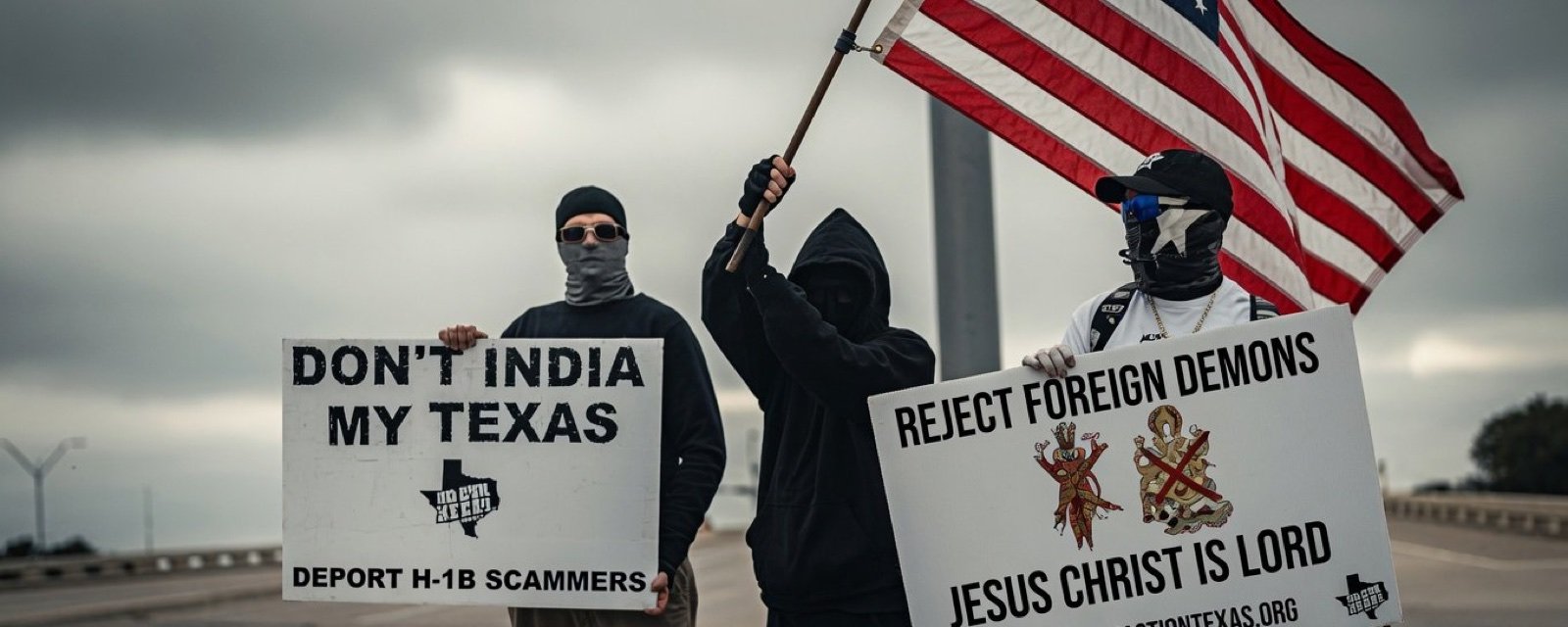
Last week, a video circulated showing an American man approaching an Indian couple in a public space and telling them to go back to India. Days before that, masked men from a far-right outfit called "Take Action Texas" gathered at multiple locations across Irving, carrying placards reading "Don't India My Texas," "Deport H-1B Scammers," and "Reject Foreign Demons," the last accompanied by crossed-out images of Hindu deities. Their post described the protest as a response to "Diwali garbage" and demographic shifts caused by "labor imports from India."
India recorded the sharpest single-market reputation decline of any country in the 2026 Global RepTrak dataset, falling 2.4 points, ahead of China, ahead of the United States. Favorable global opinion fell from 58 to 47 percent across 24 countries in a single year. More than 75 percent of anti-Asian slurs on US social media targeted South Asians between December 2024 and January 2025. A separate analysis found over 44,000 such slurs in extremist online spaces across a two-month window.
A pattern two decades in the making
The man presenting himself as a global statesman spent over a decade barred from entering the United States. When Narendra Modi was Chief Minister of Gujarat in 2002, at least two thousand people, most of them Muslim, were killed in state-wide violence. Police were ordered not to intervene. Rioters worked from detailed lists of Muslim residents and businesses. Violence happened in view of police stations. An independent media organisation captured accused individuals on hidden camera speaking openly of how the attacks carried Modi's blessing. Washington eventually rehabilitated him not because the record changed, but because a 1.4 billion-person market has a way of clarifying diplomatic priorities.
Over two decades, what followed was the systematic expansion of that architecture. Mobs chanting "Jai Shri Ram" outside mosques, through Muslim neighbourhoods, at worshippers on the way to Friday prayers, became a feature of the political calendar rather than a disruption of it. In 2024, Karnataka's High Court acquitted two men who had entered a mosque and chanted the slogan directly at worshippers, ruling the act caused no offence to any community's religious feelings. The United Christian Forum recorded 834 incidents of violence against Christians in 2024, against 139 in the year Modi came to national power. By November 2025 the count for that year had already reached 706. In Odisha, a pastor and his pregnant wife were dragged into their own church, forced to trample on Bibles, and made to chant Hindu god names while being filmed. Blind children at a Catholic centre in Gorakhpur were attacked during Christmas. Modi attended Mass in New Delhi the same week, made no public statement, and was praised for the gesture.
From the mosque in Odisha to the street in Leicester
In September 2022, masked Hindu nationalists rampaged through Belgrave Road in Leicester, targeting Muslim businesses in one of England's most historically diverse cities, communities that had fought off the National Front for decades now facing something carrying different flags but recognisable logic. Bulldozers, the instrument used in India to demolish Muslim homes as collective punishment, appeared at Hindu nationalist diaspora parades in the United States.
Then there is Harman Singh Kapoor. His restaurant, Rangrez, sits in Hammersmith, west London. He posted signs declaring the restaurant non-halal and wrote publicly: "Strictly no inbreds." His social media output included: "100 inbreds gathered outside my restaurant and blocked the door entrance. Reason: I don't sell halal. Yes this is London, Great Britain." And: "I'm not afraid to die. I'll stand my ground. F*** you, inbreds." Metropolitan Police officers detained him. He was handcuffed on camera. He framed his arrest as an attack on his Sikh faith. A migrant in London, running a restaurant in a city built on immigration, deploying the language of ethnic contempt against another minority community, became an international cause within hours. American actor Kevin Sorbo tweeted that the UK had arrested a restaurant owner for a sign saying "we don't sell halal." The "inbreds" signage and the declarations that Muslim customers were unwelcome did not travel with the story.
Researchers at Human Rights Watch and the Council on Foreign Relations documented Hindu nationalists in the US, UK, Australia, and Canada carrying out acts of violence against Muslims, Sikhs, and Christians, consistently reframing themselves as a threatened minority despite being the initiators. Research tracking UK parliamentary speeches found that communal violence in India reliably increased Islamophobic rhetoric among MPs from constituencies with larger Hindu populations, regardless of whether Hindus were the victims or instigators of the original incident.
The gap between the performance and the welcome
Over 27 million Indians travelled abroad in 2024, a 30 percent jump from pre-pandemic levels. The most recent addition to the archive arrived days ago: a video of Indian tourists performing garba on an airport tarmac in Vietnam, dancing in a circle beside a parked VietJet Air aircraft, other passengers and airport workers standing around them. Before that, garba at the 124th floor of the Burj Khalifa, garba in front of the Eiffel Tower, garba in Innsbruck where 43 Gujarati-Marwari tourists spent an afternoon pressing street musicians to play Indian music so they could dance. In July 2025, Cineworld staff in west London stopped a screening of the Telugu film Hari Hara Veera Mallu midway after audience members showered the auditorium in confetti. The floor was covered. The clip reached three million views. One audience member, when confronted, said the theatre should have put a notice outside.
A luxury spa chain in Hanoi stopped accepting group bookings from Indian men. In Switzerland, hotel lobby boards were erected requesting that Indian guests lower their voices in public areas. Hotels across Southeast Asia have reported guests stripping buffets bare and leaving rooms in states that required specialist cleaning. Thailand removed India from its visa-free entry list in 2026, placing Indian nationals under Visa on Arrival in a review linked to security and immigration concerns.
Bollywood spent six decades teaching its audience that foreign landmarks are backdrops for arrival, that locals watch with warmth, that the world is a stage waiting for the performance. The political culture of the last decade delivered the same message at higher volume: civilisational superpower, destined moment, deference owed. A hospitality consultant described the resulting attitude: travel was once aspirational, something people prepared for. The replacement mindset is that having paid for something means the world owes the service. That formation, exported in 27 million annual departures, has produced a recognisable international character. The word for it, in hotel lobbies from Zurich to Hanoi, is not admiration.
Murder as foreign policy
Canada's deputy foreign minister testified before Parliament that India's Home Minister, Amit Shah, personally orchestrated the murder of Hardeep Singh Nijjar, a Canadian Sikh citizen and temple leader in British Columbia, through a criminal network. Nijjar was shot dead in the gurdwara car park in June 2023. Four Indian nationals were subsequently arrested and charged with first-degree murder and conspiracy to commit murder. In New York, the US Department of Justice charged a former Indian intelligence officer in a murder-for-hire plot targeting a dual US-Canadian citizen and lawyer practicing in Queens, with federal prosecutors stating that an Indian government official directed the operation. The pattern of alleged Indian state involvement in assassination attempts, surveillance, and harassment extended to the US, Pakistan, Germany, the UK, and Australia.
The European Parliament adopted a formal resolution citing violence, increasing nationalistic rhetoric, and divisive policies against minorities. The United Nations-linked Global Alliance of National Human Rights Institutions deferred India's National Human Rights Commission accreditation for the second consecutive year.
The blowback reaches further than India
Pakistani Muslims in the West have spent years absorbing two distinct categories of hostility. The first, post-2001 Islamophobia, delivered by governments, tabloids, airports, and street corners with remarkable consistency. The second, the BJP's decade-long export of anti-Muslim politics through its diaspora networks, arriving in Leicester, in Hammersmith, in city councils across North America. Two forces, one target.
Now those two forces are fighting each other. The far-right nativist and the Hindu nationalist occupied the same political ecosystem for years, useful to each other in their shared contempt for Muslims. The nativist has since noticed that the Hindu nationalist is also brown, also foreign, also competing for jobs and housing and political space. Irving, Texas is the visible result.
Pakistani Muslims watching this are watching a problem, not a resolution. Community leaders in Canada explicitly described the anti-South Asian slur surge as affecting the entire South Asian community. The category the nativist reaches for is not Hindu or Indian. It is brown. A Pakistani software engineer in Toronto and an Indian software engineer in Toronto are the same person to the man carrying a "Deport H-1B Scammers" placard. The Sikh shot dead in Arizona in the days after September 2001 was not Muslim. The skin tone was close enough.
Pakistani and Muslim commentators amplifying or celebrating India-targeted venom should understand what they are feeding. A community already navigating Islamophobia, already absorbing BJP-exported hostility, now also inherits the spillover from a collision between the far right natives and the Hindu nationalist immigrants: because street-level hatred carries a single identifier. Skin tone.
India's nationalism built this. The invoice is legitimate. The problem is that it gets delivered to the whole neighbourhood. ■
Originally published on X by @DanQayyum — read the original post →