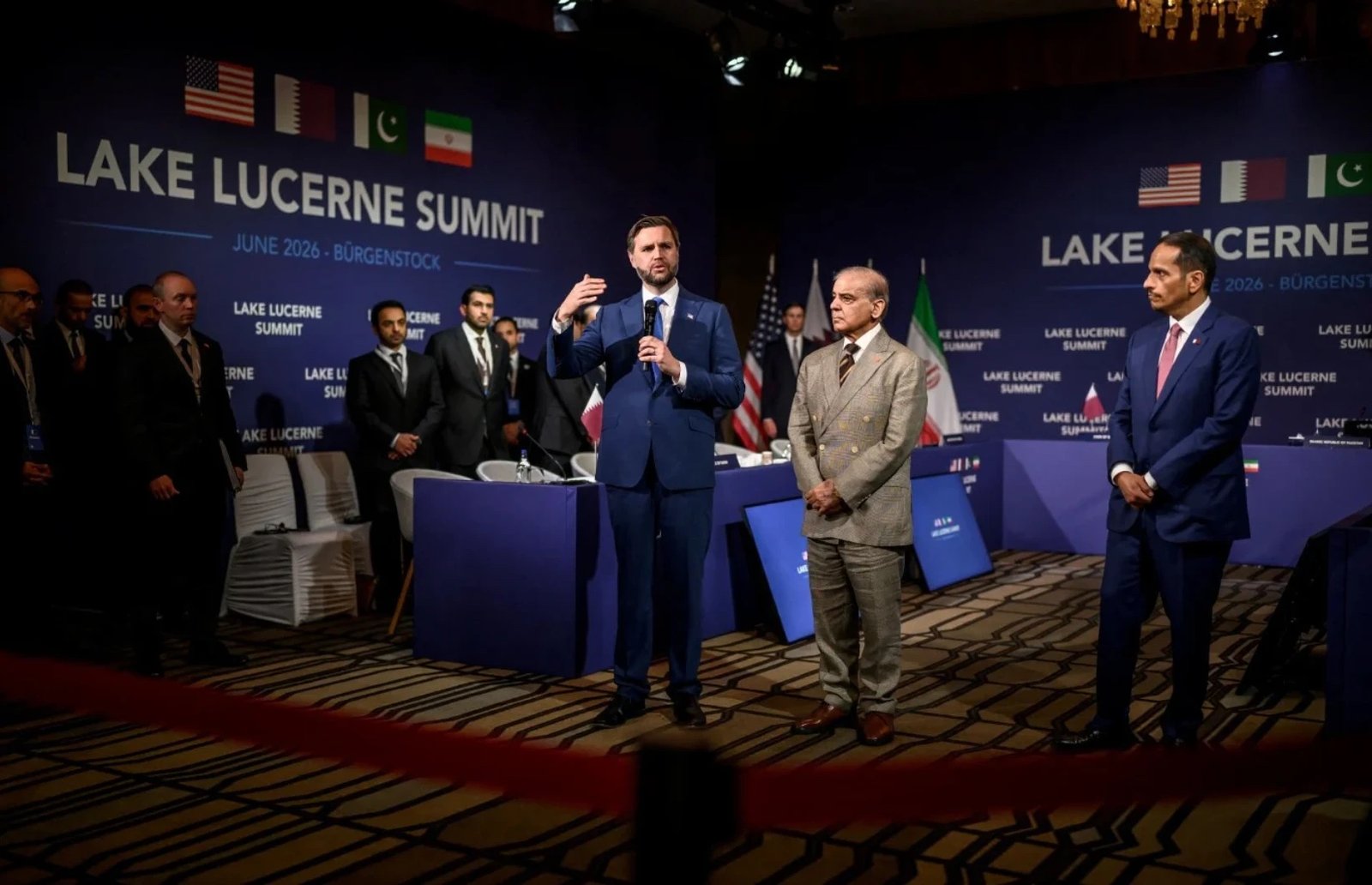
The funicular that carries guests up to the Bürgenstock resort above Lake Lucerne takes approximately three minutes. In that time, the Swiss Alps arrange themselves into a view that makes serious men briefly forget they are serious. The lake below is the colour of something a poet would ruin by describing. The air is clean in a way that feels accusatory if you have spent the last four months in the smoke of a Middle Eastern war.
JD Vance arrived at the summit this morning and, during the proceedings, said the following about Field Marshal Asim Munir: that there were two very, very important people in his life, and one of them was his wife Usha.
The other, he implied, was the Pakistani army chief, the person he's spoken to the most in the last three months.
The room received this warmly. It was the kind of remark that travels well at altitude: personal enough to feel genuine, diplomatic enough to be deniable, funny enough to briefly lift the weight of a negotiation in which the distance between agreement and catastrophe is measured in Lebanese villages and uranium enrichment percentages.
Nobody has examined it too closely. This is a mistake.
What the joke actually said
Vance arrived at Bürgenstock to do something no US Vice President had attempted in the living memory of anyone present: sit in a room with an Iranian foreign minister and discuss the future of a deal that neither side fully trusts, on a timetable that arms control experts have described as optimistic to the point of fantasy, in a resort owned by a Qatari sovereign wealth fund, with Pakistan holding the whole architecture together through a combination of institutional credibility, jugaad—which doesn't have an English equivalent but 'creative improvisation' comes close—personal relationships, and what can only be described as a very high pain threshold.
In that context, describing Munir as one of the most important people in his personal life is not just flattery. It is an accidental job description. The Vice President of the United States, whether he intended to or not, acknowledged that the relationship sustaining the most consequential American diplomatic initiative in a decade is personal. It runs between two men, one of whom was awake most nights for 111 days and the other of whom flew to Switzerland to negotiate a nuclear framework in 60 days that has historically required two years.
Two hundred and fifty diplomatic engagements. One hundred and seventy urgent international phone calls. Eighty intense in-person meetings. Forty-nine countries across five continents. A 21-hour marathon in Islamabad that produced no agreement and became the foundation for everything that followed. Munir flying to Tehran twice. The Foreign Minister flying to Beijing with a fractured shoulder. The Interior Minister in Tehran twice in a single week.
This is not the résumé of a neutral observer. It is the record of a country that believes the cost of failure is higher than the cost of persistence.
Personal relationships in diplomacy are both the most effective and the most fragile instrument available. They work until they don't. They travel until someone moves. They hold until the phone stops being answered.
The domestic labour of international peace
There is a category of work in any complex human enterprise that is essential, endless, and almost never acknowledged until it stops being done. It is the work of keeping the room together. Of absorbing the frustration that would otherwise become rupture. Of calling back after the door has been slammed. Of smoothing the interaction that would otherwise become an incident, and the incident that would otherwise become a crisis.
Pakistan has been doing this work for 111 days.
This is the diplomatic equivalent of running a household that nobody notices is being run until the day it isn't.
Vance's joke, generous as it was, captures the dynamic precisely. The most important person in your life is the one doing the work you cannot do yourself, whose contribution you register in personal rather than institutional terms, and whose absence would be felt before it was understood.
The question the joke does not answer is what happens when the 60 days are up.
The resort and the reality outside it
While the delegations discuss frameworks in Bürgenstock's conference rooms, Israeli air strikes continued in southern Lebanon. National Security Minister Ben-Gvir, from the cabinet of America's closest remaining regional partner, posted that all of Lebanon must burn. Finance Minister Smotrich called for opening the gates of hell. Defence Minister Katz said the 200,000 Lebanese residents in the occupied security zone would not return. None of them.
Lebanon's Health Ministry counted 4,057 dead since March 2. UNICEF reported twelve children killed or maimed every single day. The Strait of Hormuz, which Iran closed on Saturday citing Israeli ceasefire violations, remained operationally contested.
The air at Bürgenstock stayed clean. The view stayed extraordinary. The funicular kept running.
What personal warmth costs
There is a version of the next 60 days in which Vance's remark ages well. The nuclear talks produce a framework. Lebanon stabilises. The Strait reopens definitively. Pakistan's role is formally acknowledged in a way that outlasts the personal relationship that currently sustains it.
There is another version. The talks stall on enrichment levels. Israeli operations in Lebanon continue. Iran closes the Strait again. The 60-day window expires with the central questions unanswered. And the most important person in JD Vance's life receives a phone call that is harder to return than the ones that came before.
Personal warmth in diplomacy is real and it matters. It is also, by its nature, time-limited. The institutional question—what Pakistan's role looks like once the personal relationships that built the Islamabad MOU are no longer sufficient to sustain it—is the question Bürgenstock has not yet been asked to answer.
Vance's joke will be quoted for a while. It is genuinely funny, genuinely warm, and genuinely revealing. In the annals of diplomatic compliments paid at alpine resorts above Swiss lakes, it may be the most memorable line of the summit.
The sixty-day clock is less sentimental. ■