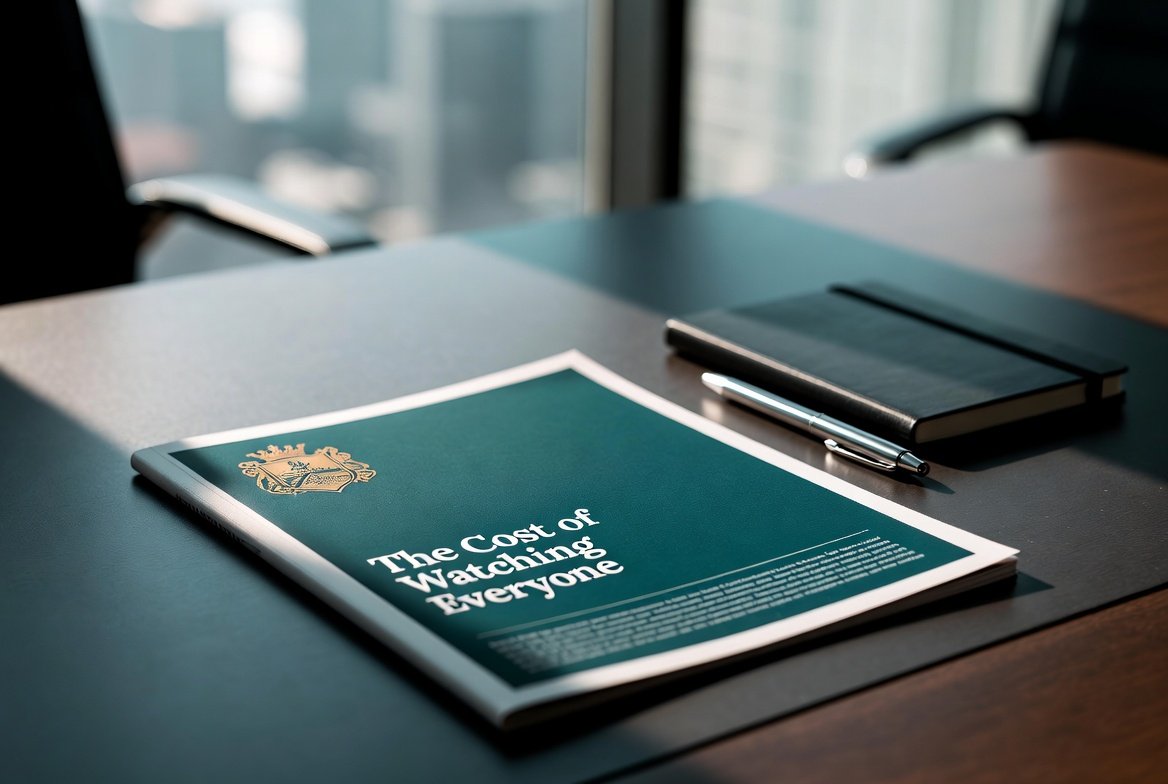
A new Strategic Assessment Paper from The Pakistan Playbook.
The argument in one line: the only thing that ever really limited tyranny was the cost of watching everyone, and artificial intelligence has just removed it.
For all of history, total surveillance was too expensive to sustain. Watching a whole population meant armies of human watchers no state could afford, so even the worst regimes could only watch some of the people some of the time. The East German Stasi came closest, with one informer for every six or seven citizens, and it still collapsed, because it drowned in more paper than it could ever read. That unaffordability was the space where private life survived.
AI removes that constraint. It makes watching everyone cheap for the first time, at the exact moment when biometric ID, facial recognition and linked databases have been built almost everywhere, by democracies and developing states alike, for reasons that were entirely real: welfare, fraud control, counter-terrorism. The infrastructure is already in place. What has changed is the price of using it.
Then the paper makes an argument few have made. Dictatorships fall when a silent, frightened population suddenly discovers it was the majority all along. The regime never sees it coming, because it cannot see who its enemies are. AI surveillance fixes that blindness. It finds the dissenters before they find each other, and removes the few whose courage would start the cascade. The technology now arriving is not just built to watch. It is built to make sure that moment never comes.
The paper traces all of it, from the Stasi to Xinjiang to Aadhaar and NADRA, and it does not end in despair. The cost of watching everyone has collapsed, so the limit that history once supplied for free now has to be built by hand. That means keeping the state body that holds your biometric data separate from the one that polices you. It means writing purpose limits into law, so a database built for welfare cannot be quietly turned on dissenters. It means sunset clauses that make emergency powers expire instead of harden, and it means protecting the courts and the press, which are the only brake left once watching becomes cheap. None of it is exotic. It is the ordinary machinery of a state that intends to stay free, and the window to build it closes as the surveillance matures.
Download the full Strategic Assessment Paper →
Enter your name and email to access The Cost of Watching Everyone: Artificial Intelligence, the Political Economy of Total Surveillance, and the Neutralisation of Revolt.