Saudi Arabia, Pakistan and Turkey have signed an agreement treating an attack on one as an attack on all. What it changes between Pakistan and India.
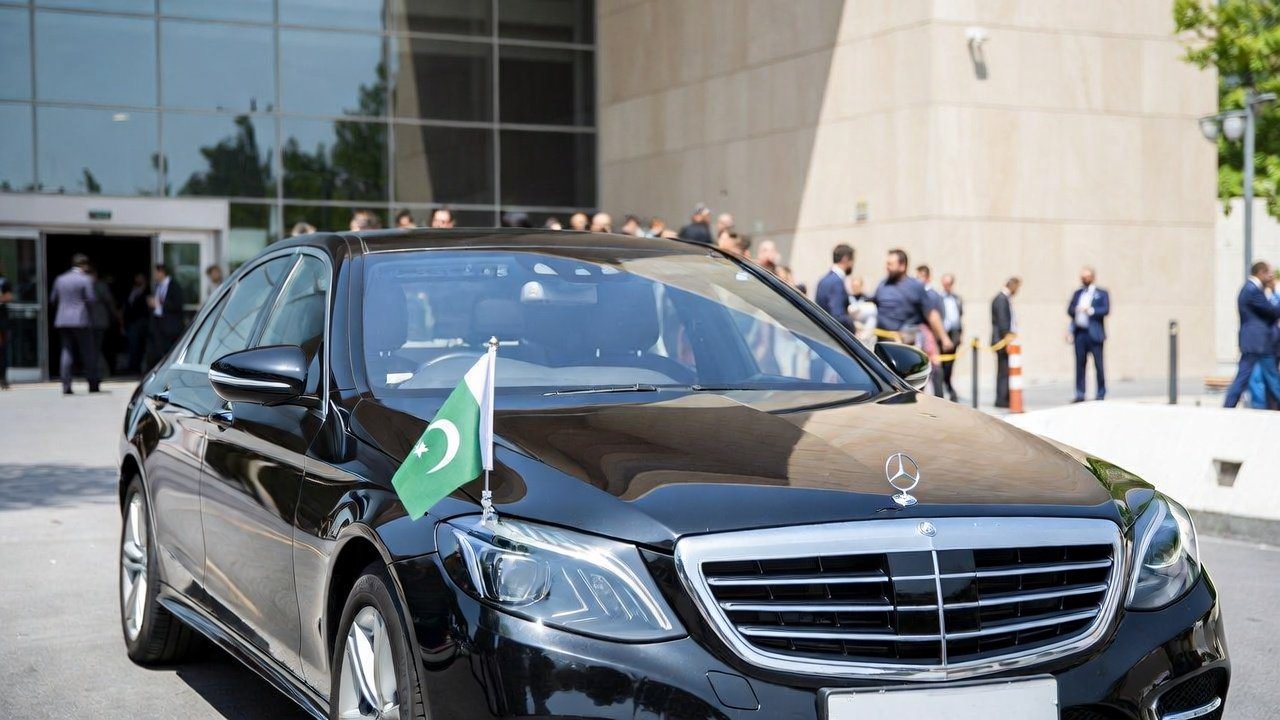
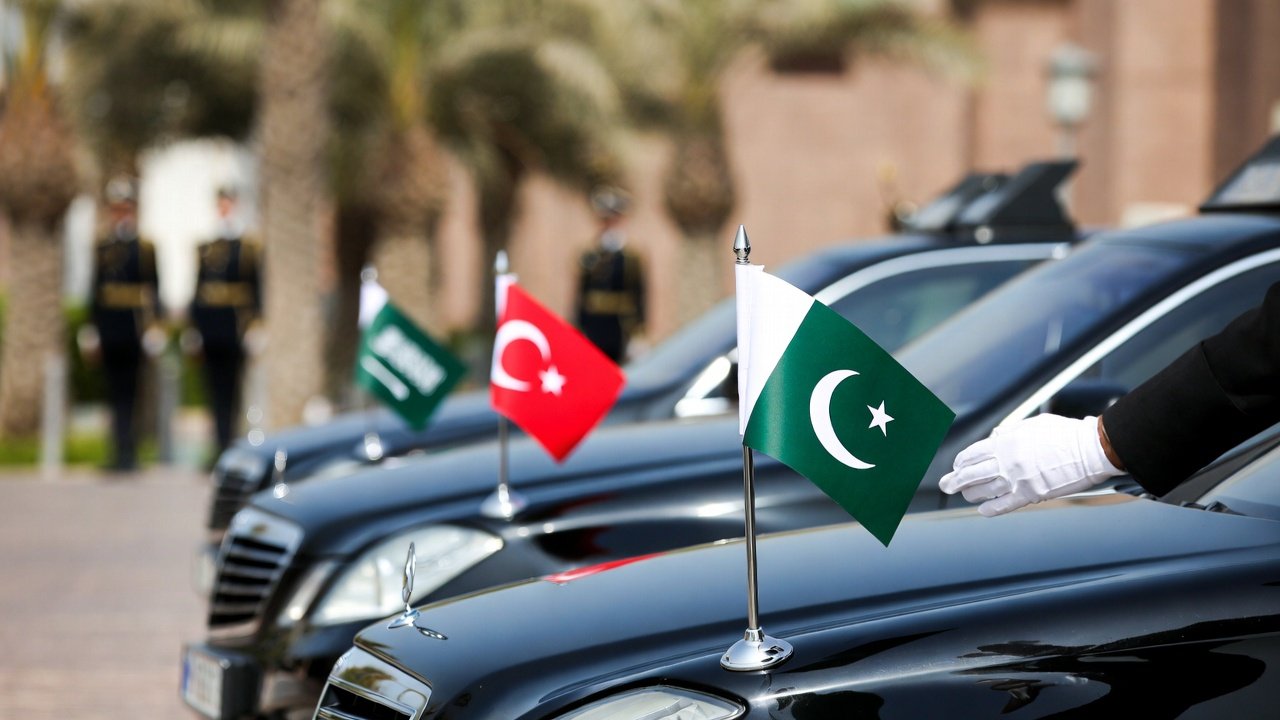
Protocol flags of Pakistan, Turkey and Saudi Arabia, Jeddah, 7 August 2026.
On Friday morning, before Turkey's president had landed in the kingdom, Pakistan's prime minister and its army chief performed Umrah in Mecca. Hours later, in the same city, Shehbaz Sharif, Recep Tayyip Erdogan and Crown Prince Mohammed bin Salman signed the Mecca Joint Defence Agreement, under which an armed attack on any of the three states will be treated as an attack on all. The choreography was deliberate. A defence treaty sealed at Islam's holiest site, by three governments that together hold the Muslim world's only nuclear arsenal, NATO's second-largest army and the Gulf's deepest treasury.
The joint statement named no adversary. The pact was drafted against the backdrop of the Iran war and the Houthi campaign against the Gulf, and its immediate purpose sits in that theatre. Pakistani readers are asking a different question, and Indian analysts are asking the same one. What does this agreement change between Pakistan and India. The answer is specific, and it begins with what happened in May 2025.
The Lesson of Sindoor
The May 2025 conflict settled an old argument about what external support in an India-Pakistan war actually looks like. Foreign soldiers never entered the picture. The fighting was done by Pakistanis. The air battle of 7 May was won by Pakistan Air Force pilots and controllers who integrated aircraft, missiles, airborne surveillance and a domestically built data link into a kill chain that a United States Congressional commission later credited with exposing structural weaknesses in Indian airpower. The equipment came from abroad. The men, the network and the execution were Pakistan's own.
What arrived from outside was hardware and cover. Chinese aircraft, missiles and sensors formed the backbone of the winning system. Turkish drones, including Bayraktar platforms, flew in the fighting, and Azerbaijani drones supplemented them. Through the same days, Ankara defended Pakistan's position publicly and absorbed Delhi's protests without adjusting a word.
Pakistan fought that war with its own forces and other countries' industries. The distinction matters, because it defines what a defence pact with Riyadh and Ankara can and cannot add. Pakistan's deterrent against India is complete on its own terms, and its nuclear doctrine is directed at India alone. No clause signed in Mecca changes that arithmetic, and no member of the pact will place troops on that front. What the agreement does is take the layer of support that decided how Sindoor was supplied and narrated, and give it the permanence of treaty.
Riyadh's Leverage
Saudi Arabia's weight in an India-Pakistan crisis runs through Delhi's own balance sheet. India counts the kingdom as its fifth-largest trading partner, and Saudi Arabia counts India as its second-largest, with bilateral trade near forty-three billion dollars. Riyadh has publicised investment intentions in India of up to one hundred billion dollars across energy, refining, petrochemicals and infrastructure, with Aramco attached to major downstream projects on India's west coast. Millions of Indian workers in the kingdom send home one of the largest remittance flows in the world, and Saudi crude remains a pillar of Indian energy imports.
Each of those figures has been read in Delhi, for years, as evidence of a deepening partnership. After Friday they read simultaneously as exposure. The kingdom that holds those levers has now bound its security to Pakistan's by treaty, twice in eleven months. In a future crisis, Riyadh's instruments are the pace of an investment, the language of an OIC communique, the framing offered to Washington, the schedule of an oil contract. Instruments of that kind leave no debris and require no announcement. Their availability alone alters how Delhi must plan, because every escalation ladder now runs through a capital with a treaty obligation to the other side.
Ankara's Industry
Turkey's contribution is the one with a combat record. The drones it supplied before and during Sindoor will be joined by more of everything, because the industrial relationship is compounding. Around two hundred Pakistani engineers are embedded in the KAAN fifth-generation fighter programme, with first induction into the Pakistan Air Force expected by 2028. Turkish naval and aviation platforms already serve in Pakistani colours. Saudi Arabia joined this supply chain from the demand side in 2023, when Riyadh's purchase of Turkish drones became Ankara's largest defence export contract.
The pact places all of this inside a single framework. The three governments have described defence-industrial integration and joint technological development as core purposes of their alignment, and the division of labour writes itself. Turkey and Pakistan hold the engineering talent and the production lines. Saudi Arabia holds the capital that can scale both. A joint research and development base funded from Riyadh and built in Ankara and Islamabad would mature over a decade, and every system it produces lands on the same side of the subcontinental balance. India's procurement, meanwhile, remains anchored to Western suppliers who withhold source codes and to an indigenous fifth-generation programme its own defence establishment does not expect before 2035.
The Bottom Line
The Mecca agreement adds no divisions to the Line of Control and was never designed to. It converts into treaty form the two currencies that shaped the last India-Pakistan war: diplomatic cover from capitals India cannot afford to alienate, and a weapons pipeline that grows more integrated each year. Pakistan emerges with its deterrent unchanged, its airmen proven, and its hinterland deepened. India emerges with a new entry in every crisis calculation, the knowledge that its largest Gulf partner now carries a defence obligation to Islamabad, and that the industrial base arming Pakistan has acquired a treasury.
Several questions remain open. The pact's specific obligations are unpublished. The mechanisms, joint commands, consultative councils or funding vehicles, have not been announced. Whether further states accede, and which, will determine if the agreement remains a triangle or becomes a bloc. The Pakistan Playbook will continue to report on the agreement's terms as they emerge.