Last week a crowd in Delhi stood in front of Parliament and abused the Prime Minister of India by name. Not in code, not in the careful language of opposition press conferences, but the real thing, the words you do not print, thousands of young people saying them out loud into cameras. Within days a cabinet minister was gone and the government was at a table negotiating the terms of its retreat. Both of those things were unthinkable a month earlier. Both happened inside a fortnight.
What Was There Before
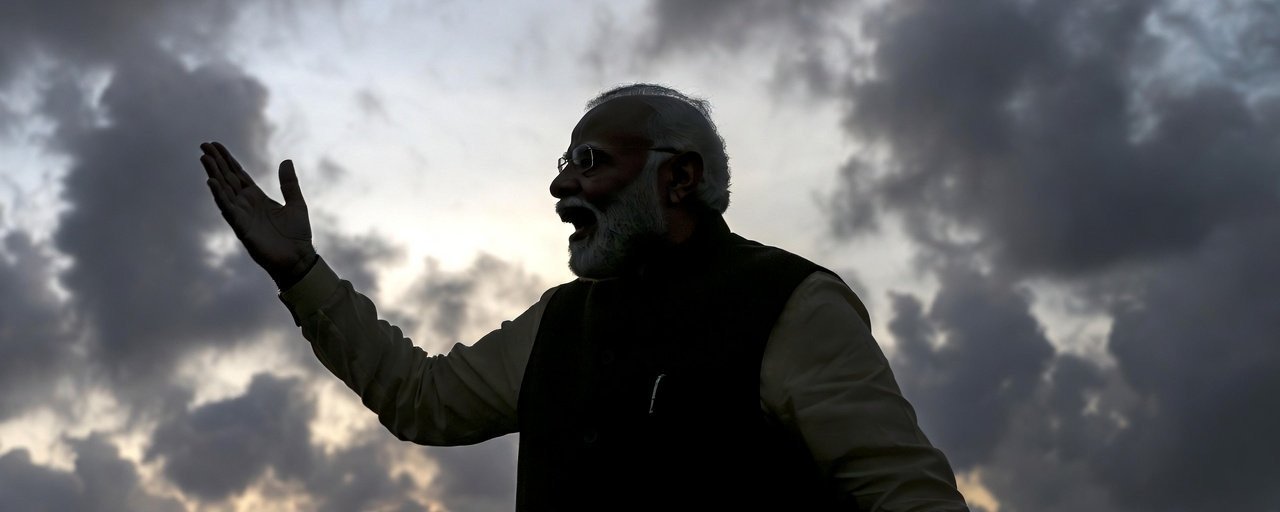
For twelve years Narendra Modi was not a politician in the ordinary sense. He was a presence. His face opened the newspaper and closed the evening bulletin. His name went on the vaccine certificate and the bag of subsidised grain. He did not sit for interviews where a journalist might ask him something he had not approved, and he did not need to, because the country had been arranged so that the question would not be asked. He was the state, the nation and the man at once, and to go at one was to go at all three.
Every powerful man has a past. His was not hidden. It sat in court records and old news archives and the memories of people who had been there, available to anyone who went looking. The machine's achievement was never concealment. It was making the known unsayable. You could read the whole of it in a book and still not repeat it at a dinner table, because the cost had been set too high, and everyone had privately agreed to pay it by staying quiet.
The enforcement was not subtle. A Muslim trader lynched on camera. A journalist who lost her slot. A student booked under a terror law and left in a cell for five years without a trial. A comedian jailed over a joke he had not yet told. The andhbhakts did the daily work, the swarming and the doxxing and the complaint that brought the police, and the lesson landed on everybody watching. There was a line, and the people who crossed it were made into examples so the rest would not.
It worked because fear always works, right up until someone tests it and lives.
The Test
Then a paper leaked. It leaked the way these papers always leak, sold ahead of time to families who could pay, and more than two million young people worked out in the same week that the result was settled before they walked in. They were the generation raised entirely inside his India. They had never known another Prime Minister. They turned out to be the ones with no fear to lose, because a fear has to be made in front of you before you will carry it, and they had arrived too late to watch it being made.
So they said his name. All of it, everything that had gone unsaid for twelve years, shouted by children who had done the sum and found the man who took their future standing where the neighbour was supposed to be. The machine reached for the old lever. The Delhi Police announced foreign handles, Pakistani accounts, the familiar hand behind the unrest. Nobody moved. They had heard it before and this time they laughed at it.
Then something happened that told you more than the resignation did. Modi sat alone and filmed himself on a phone, saying he was upset about the leaks and would act. For twelve years he had spoken only in set-piece addresses and scripted monthly broadcasts, never an unplanned word, never a question he had not seen coming. The man who had never had to explain himself was explaining himself, into a phone camera, because he had run out of other options and knew it. The pedestal does not survive the man climbing down to record a piece to camera.
The minister went two days later. The government that does not negotiate sat next to the protesters at a press table and agreed to their terms. It was over in five weeks.
What Ended and What Did Not
He is still Prime Minister. The party is intact, the machinery is intact, the ideology that fed the mobs is intact. The RSS has already stepped in to steady the ship, the strategists are already writing the script for recovery, and the BJP is reported to be nervous about the state elections in 2027 rather than resigned to defeat. Nervous is not finished. The next time a mosque or a border or a cricket match lights the fuse, much of the old machine will come roaring back. This is not the end of the danger, and nobody should tell you it is.
What has ended is the untouchability. For twelve years he stood above the country like something that could not be reached, and last week the country reached up and pulled him down to the size of a man who fires a minister to save himself and films an apology on his phone. That specific thing, the myth of the figure beyond criticism, does not come back. It cannot, because fear of this kind is a shared illusion, and it holds only while nobody breaks it. The first crowd that shouts and walks away unbroken has shown every crowd after it that the shouting can be survived. You cannot un-teach that. A whole country has now watched him lose to teenagers, and there is no announcement, no arrest, no broadcast that unwinds the watching.
Twelve years went into building one thing above all others, the idea that he was larger than the people and beyond their reach. It was undone in a fortnight by the people it was built to overawe.
He was one man, elevated above all others, his single face on every surface. What beat him had no face at all. No leader to arrest, no figurehead to smear, no single throat to reach for. A movement named after an insult a judge had thrown at the young, led by nobody, owned by everybody, that took what it came for and went home. He spent twelve years making himself the only person in India who mattered. He was brought down by the one thing his design could not account for, a crowd that did not need a great man to follow. ■
Dan Qayyum is a writer, media strategist, and long-standing advisor to government institutions and media organizations across the region. His work explores the intersections of geopolitics, military doctrine, and regional transformation. His upcoming book, The Other Side of Endurance, examines his own journey through crisis, resilience, and reinvention.