Within a day of a gunfight in Kashmir, Indian media had given a dead militant a Pakistan Army career, a service number and an identity card. On 1 October, the man named on that card sat beside Pakistan’s military spokesman in Islamabad and confirmed he was alive.
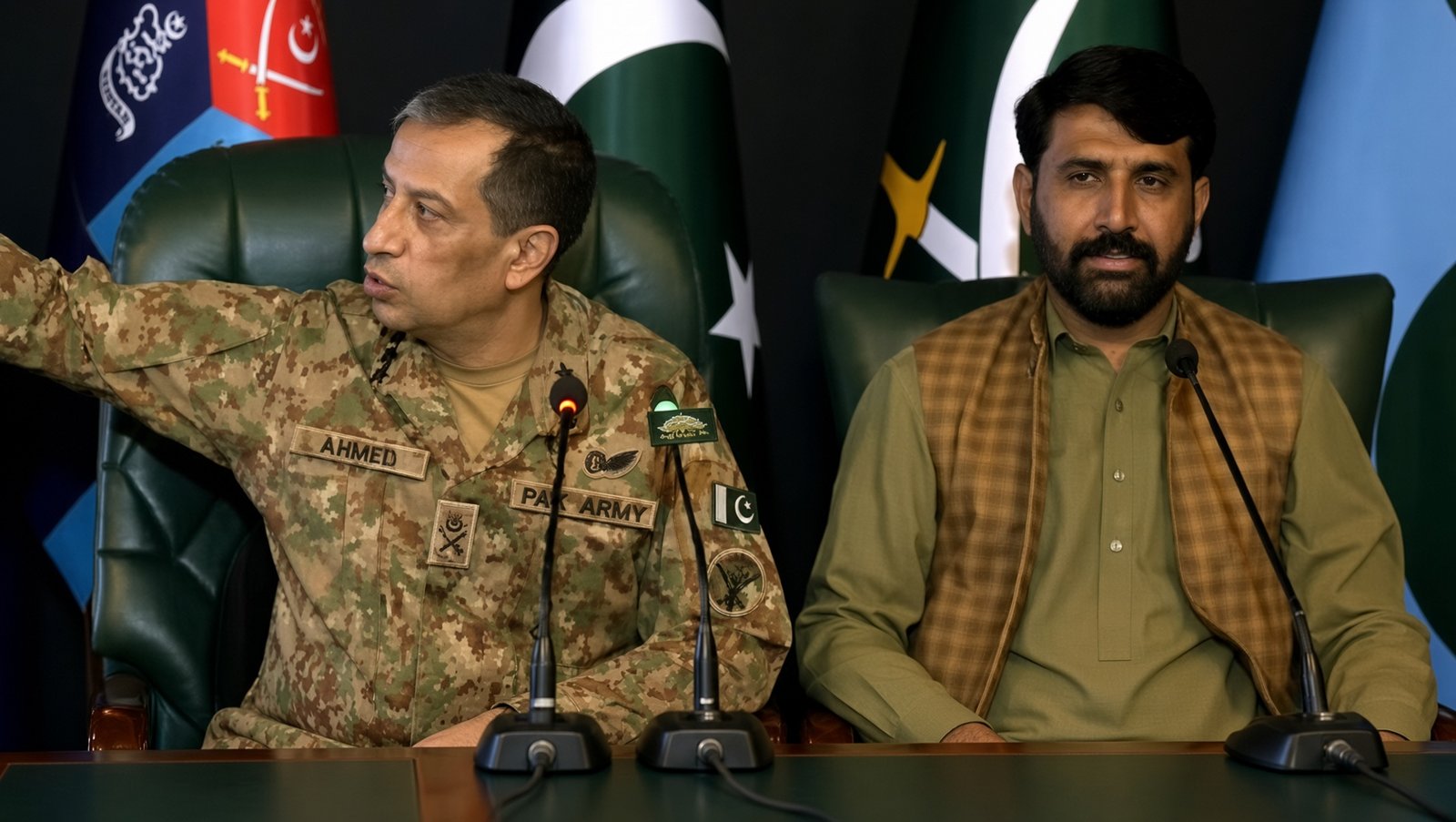
At about half past five on the afternoon of 1 October, Lt Gen Ahmed Sharif Chaudhry, Director General of Inter-Services Public Relations, turned to the man beside him at a press conference in Islamabad and asked whether he had been martyred. Mohammad Asif, a former Pakistan Army havildar from Attock, said he was very much alive. The room had been laughing for some time. It laughed again.
Asif told reporters that friends had phoned to say India had killed him in Kashmir, and to ask where he was. He said he reported to his unit, and ISPR got in touch after that. The DG had brought him on with a question: “Kahan hai ye superman? Let’s have him out here.” Where is this superman?
Twenty-Four Hours in the Life of a Dead Man
On the night of 29 September, the Indian Army’s Chinar Corps announced a joint search operation in the Korag area of Yousmarg, in Budgam district. ‘One terrorist had been neutralised.’ The post gave no name.
On the morning of 30 September, the Chinar Corps reported that the body had been recovered at Palmaidan and identified as Mohammad Asif alias Hashim Moosa, a ‘Pakistan-based Lashkar-e-Taiba militant.’
That afternoon, between 14:20 and 15:33 by ISPR’s timeline, ANI published a military biography credited to unnamed sources. In ANI’s version, the dead man was born on 7 March 1980 and joined the Pakistan Army in 2000 under service number PA-3106947. He moved to the Special Services Group in 2005 and served with the 4 Commando “Yalgar” Battalion. From 2006 he was in Balochistan, where he was credited with around ten operations and thirteen personal kills. He spent 2006 to 2009 on Pervez Musharraf’s security detail, and left the army as a havildar. India TV put the retirement date at 31 March 2023. ANI attached an image of a Pakistani identity card issued on 12 September 2020, alongside a verification screen marked “Verified.”
Later that day, India’s Ministry of Home Affairs issued a statement through the Press Information Bureau. The dead man was now “Musa aka Asif Fauji,” killed at Gurwatkalan in the Khansahib police station area. The ministry called it a serious blow to the Lashkar ecosystem in Jammu and Kashmir. The statement does not mention the SSG, the Pakistan Army, Musharraf or a service number. No Indian official has gone on the record with the army biography.
Copy, Paste, Publish
The press supplied the military career. Within hours, the SSG biography was running as fact on PTI, India’s largest wire service, and across NDTV, India Today, the Times of India, ABP, The Statesman and India TV. Headlines ranged from “ex-Pak Army commando” to “Musharraf’s guard” to “Pahalgam mastermind.” Every version rested on unnamed sources. None of the reports reviewed for this piece cited an attempt to reach the Pakistan Army, ISPR or Asif’s family. His friends managed to find him.
The commentary went further than the copy. Verified accounts on X called the file direct proof of Pakistani state sponsorship of terrorism. One told sceptics: “Photos can be denied. Service records are harder to erase.” On that point, Havildar Asif agrees.
The Indian file placed his family in Attock. That part was accurate.
The Superman Problem
The Home Ministry said Musa’s group of four commanders had been active in Jammu and Kashmir since 2022. It credited them with the Kandi attack in May 2023, Halan in August 2023, Dera Ki Gali in December 2023, Shahsitar in May 2024, Shiv Khori in June 2024, Gagangir and Bootapathri in October 2024, and Baisaran, the Pahalgam attack, in April 2025.
India’s sources do not agree on when he arrived to do any of it. ANI’s file has him in Pakistan Army uniform until 2023. After Pahalgam in 2025, security sources told The Tribune he had infiltrated in September 2023, after being dismissed from Pakistan’s para forces. On 30 September this year, officials told PTI he had come over in 2021, after retiring, and had been hunted for five years.
Taken together, India’s sources have him entering Kashmir two years before he left the army. He was dismissed in one account and retired in another. The group he supposedly belonged to was active in Kashmir from 2022, while ANI still had him in uniform.
Hence the DG’s “superman.”
A Name for Every Season
On 23 April 2025, the day after Pahalgam, Indian security agencies released sketches of three Pakistani suspects: Asif Fauji, Suleman Shah and Abu Talha, with code names Moosa, Yunus and Asif. The Deccan Herald reported that Asif Fauji was believed to lead the group, and that he might have Pakistan Army ties, since “Fauji” means soldier. Indian reporting at the time also named a suspect as Hashim Musa alias Sulaiman.
On 30 September 2026, the officials briefing PTI listed Sulaiman Shah as one of Asif’s aliases. The Home Ministry, the same day, listed Suleman as a different militant, killed in 2025. On 1 October, Hindustan Times described Asif as a close associate of Suleman Shah, whom it called the architect of Pahalgam. Depending on the source, Asif was Suleman Shah, worked for Suleman Shah, or outlived him by a year.
On 30 September, the Times of India called Asif the Pahalgam mastermind. The next day, Hindustan Times had him as the mastermind’s aide. Neither paper consulted the man in question. On 1 October, he was speaking to the press.
Encounteristan
The DG spent the rest of the afternoon on India, which he said had gone “from Hindustan to Encounteristan,” a country “great without greatness, historical without history.” He then repeated an offer Pakistan has been making for years: “If you have evidence, please come forward. If you don’t want to give it to us, give it to any third party.”
After gunmen killed 26 people at Pahalgam on 22 April 2025, Prime Minister Shehbaz Sharif offered a neutral and transparent investigation. India did not take it up. On 7 May it struck Pakistan, and four days of fighting followed. India denied losing any aircraft until 31 May, when its Chief of Defence Staff, Gen Anil Chauhan, conceded losses at the Shangri-La Dialogue in Singapore and declined to say how many. In August, three months after the ceasefire, India’s Air Chief Marshal announced that India had shot down six Pakistani aircraft. The DG asked what kind of country has an air chief who wakes up months after a war and remembers shooting down planes.
India went to war in 2025 on an attribution it never put to a neutral test. In 2026, it attributed a body in Budgam to a man Pakistan could put on a stage.
Somewhere in Indian custody lies the body of a man killed above Yousmarg on 29 September. On 1 October, the name India gave him was in Islamabad, telling a room full of reporters he was pretty sure he had not been martyred. ■
Dan Qayyum is the editor of The Pakistan Playbook.