Saudi-backed Yemeni forces have launched an offensive to reverse the Houthi capture of Yemen’s Red Sea coast, and the Mecca defence pact has been formally activated. Pakistan already has troops, aircraft and weapons in the theatre. How far Islamabad goes next will be set by the credibility of its defence pacts, the depth of its relationship with Riyadh and a war still running on its western border.
Where Things Stand
The current escalation began in July, when Iran flew a Houthi delegation into Sanaa without Saudi authorisation, Riyadh struck Sanaa airport, and the Houthis hit Saudi territory for the first time since 2022. The Houthis targeted a Saudi airport on 13 July and on 20 July announced a maritime embargo against the kingdom. After the Houthis claimed strikes on Saudi tankers, the Saudi-led coalition bombed Houthi military sites in Hodeidah on 24 July, and the following day the Houthis fired on Saudi oil installations at two Red Sea ports.
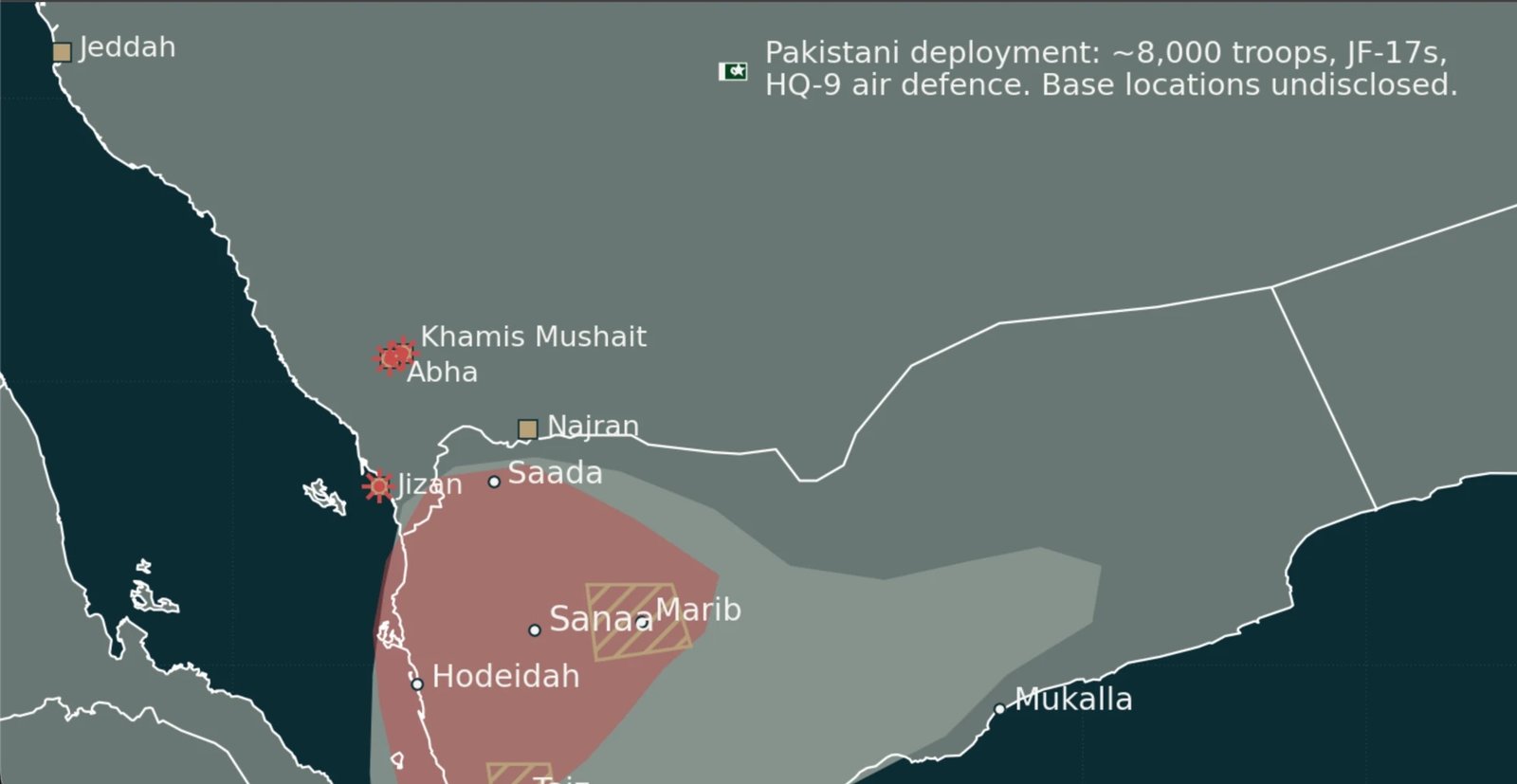
In September the Houthis seized Mocha, extending their hold over the Bab el-Mandeb strait. They also took Zuqar, Mayyun/Perim and the Hanish Islands, while government forces withdrew from several positions after heavy losses. In one of the largest attacks on the kingdom since the Iran war began in February, the Houthis hit an airbase at Khamis Mushait and nearby oil infrastructure, wounding 73 people.
On 5 October, the Saudi-led coalition launched a major offensive under air cover, with its spokesman saying 100 fighter jets were supporting Yemeni government forces, and Yemeni officials said several key areas around Bab el-Mandeb had been recaptured. The government says the campaign will continue until all Houthi-held territory is retaken, and Yemeni military officials have announced an offensive on Sanaa. The Houthis responded the same day by claiming strikes on Riyadh’s international airport, an Aramco refinery and other sites across the kingdom’s south.
Washington is providing intelligence and targeting support but has stayed out of the fighting. The United States rebuffed Saudi requests to conduct airstrikes, with CENTCOM viewing Yemen as a distraction from Iran.
What Pakistan Has Already Committed
Pakistan’s obligations rest on two agreements. The September 2025 Strategic Mutual Defence Agreement with Saudi Arabia treats aggression against either country as aggression against both. On 7 August 2026, Mohammed bin Salman, Recep Tayyip Erdogan and Shehbaz Sharif signed the Mecca Joint Defence Agreement, extending the same principle to all three states.
In April, Pakistan deployed around 8,000 troops, a JF-17 squadron and HQ-9 long-range air defence systems to the kingdom under the 2025 pact. Other reporting puts the package at 16 JF-17s, combat drone squadrons and a surface-to-air missile battery. In September, Pakistan sent four cargo planes of air defence systems, light artillery, drones and anti-drone systems to Aden, and Pakistani military advisers are on the ground alongside Saudi counterparts supporting Yemeni government forces.
On 10 September, after the Khamis Mushait strike, the Foreign Office said no military response under the Mecca agreement was under discussion, but that Pakistan would act under the agreement when the time came. The time came on 5 October. At an emergency meeting in Riyadh attended by Deputy Prime Minister Ishaq Dar, Saudi Defence Minister Khalid bin Salman and Turkish Foreign Minister Hakan Fidan, the three states agreed to activate deterrence measures under the pact and rapidly deploy forces to the kingdom. The joint statement condemned the attempted targeting of Mecca and Madinah and continuing attacks on Saudi cities and economic facilities. It did not specify the size of the deployment or the role the troops would fill.
The agreed limit was set earlier in Riyadh. Saudi Arabia, Pakistan and Turkey have agreed their forces will not enter Yemen and that any response will be launched from Saudi territory. Speaking on Geo after the Riyadh meeting, Khawaja Asif said Pakistan and Turkey both had a presence in the theatre, but that Saudi forces were the only troops engaged in combat operations.
The limit applies to combat forces. Pakistani equipment and Pakistani officers are already on Yemeni soil.
The Precedent
In April 2015, Pakistan’s parliament unanimously resolved to stay neutral in Yemen, citing fears of sectarian tension at home and damage to relations with Iran, while restating Pakistan’s commitment to defend Saudi territory. Pakistan still provided some naval assistance in the early phase of the Saudi campaign. In 2018, the government sent 1,000 troops to the kingdom to train and advise, and told the Senate the deployment did not breach the resolution.
The pattern has held for eleven years. Islamabad declines Yemen and commits to Saudi Arabia, and the space between those two positions has been filled with a little more each time.
The Options
Hold the perimeter. Pakistani forces defend Saudi airspace, the southern border and critical infrastructure. Andreas Krieg of King’s College London argues Riyadh needs exactly this so that Saudi forces have more freedom to operate against the Houthis. The activation of the Mecca pact has turned this from an option into stated policy. It fits the text of both pacts, keeps Pakistani forces inside the country they are sworn to defend, and is the easiest course to defend in Islamabad. With the Houthis now firing at Riyadh, the holy cities and Aramco facilities across the kingdom, it is also the option with the most immediate military demand behind it.
Deepen support inside Yemen. More advisers, more weapons to Aden, training and intelligence for the government’s forces as they push towards Bab el-Mandeb and Sanaa. This is already under way. Its cost is low until the first Pakistani is killed in Yemen, at which point the official distinction between Saudi soil and Yemeni soil stops meaning anything in domestic debate.
Strike from Saudi territory. The agreed formula permits it. Pakistani JF-17s and drone squadrons are in the kingdom, and a sortie launched from a Saudi base into Yemen satisfies the letter of the trilateral understanding. Asif’s statement that only Saudi forces are in combat is the clearest official line yet that this has not happened. It also leaves the door open: the formula that keeps Pakistani forces out of Yemen was written to allow exactly this kind of action. The Houthis will draw no distinction between a Pakistani aircraft that took off in Saudi Arabia and one that took off in Yemen, and Pakistani units in the kingdom would become targets in their own right.
Naval and maritime role. Escort or interdiction work in the Red Sea and Gulf of Aden, with a 2015 precedent behind it. One analysis of the pact’s options anticipated Pakistan pushing for a multinational naval coalition to secure Bab el-Mandeb. With the strait now contested ground, any Pakistani warship operating there sits inside the range of Houthi anti-ship weapons.
Ground forces in Yemen. Effectively excluded. It breaches the trilateral understanding, and the offensive is led on the ground by Yemeni government forces with Saudi air cover. Princeton’s Bernard Haykel expects any Pakistani role to stop at the border.
What Actually Decides It
The credibility of the pacts. The 2025 agreement and the Mecca agreement are the frame through which Pakistan has presented its standing since May 2025. The Houthi campaign was the first live test of either, and on 5 October all three signatories answered it in writing. Activation raises the stakes of delivery. A pact invoked and then thinly honoured would reprice it in Riyadh, in Ankara, and in every capital that read it as Pakistan’s arrival as a regional security provider. The joint statement’s reference to attacks on Mecca and Madinah ties the obligation to a commitment Pakistan has carried for decades: the 2015 resolution that kept Pakistan out of Yemen restated the defence of Saudi territory, home to the two holy mosques, in the same text. The public descriptions of both pacts frame the obligation around attacks on a signatory. Defending Saudi territory falls squarely inside that. Offensive operations in Yemen do not, which gives Islamabad room to stop at the border while claiming full compliance.
The relationship. The Saudi-Pakistani security partnership and the financial one have grown together over five decades and are now difficult to separate. Under Pakistan’s $7 billion IMF programme, Saudi Arabia, China and the UAE committed to maintain $12.5 billion in combined deposits with the State Bank of Pakistan, and when the UAE withdrew part of its support, Riyadh filled the gap and lifted its exposure to $8 billion. In 2015, the year parliament declined Yemen, the equivalent figure was a $1.5 billion loan. An $8 billion deposit is an exposure for the lender as well as support for the borrower, and the dependence runs both ways on the military side too: the Saudi war plan relies on Pakistani air defence and ground forces in the kingdom to free Saudi units for Yemen. The same relationship governs Pakistan’s fuel. Petroleum imports, mainly sourced from Saudi Arabia, make up a major share of Pakistan’s import bill, and Islamabad is negotiating a $6.7 billion deferred-payment oil arrangement with Riyadh over fifteen years. Houthi strikes on Aramco refineries and on Saudi shipping are strikes on Pakistan’s own supply, and their effects would reach Pakistani fuel stations as surely as Saudi export terminals.
Bandwidth. Pakistan is fighting on its western frontier. The worst Pakistan-Afghanistan fighting in years came in February, and a Pakistani airstrike on Kabul in March killed more than 400 people. The current round began on 18 September after a suicide attack on a police compound killed 31, and on 24 September Pakistan struck ten targets in Afghanistan. Every JF-17 and air defence battery committed to Saudi Arabia under the new deployment is one not available over Khyber Pakhtunkhwa or Balochistan.
Domestic politics. Around a fifth of Pakistanis are Shia, the second-largest Shia population after Iran, and sectarian blowback was the core argument against intervention in 2015. The parliamentary brake that operated then depended on a civilian leadership willing to use it. The balance of authority between the civilian government and the military has shifted materially since then. Attacks on the holy cities also change the domestic arithmetic: the defence of Mecca and Madinah commands support across Pakistan’s political spectrum in a way that a war in Yemen never has.
Iran. The 900-kilometre border and the Balochistan file are permanent constraints. Islamabad has also kept a working channel to Tehran. It delivered a Saudi warning to Iran to rein in the Houthis, and a senior Iranian official replied that Iran does not control them; the same reporting says several IRGC commanders had travelled to Yemen to help coordinate the Houthi campaign. Asif continues to press for negotiations on the wider conflict. The relationship with Tehran shapes how Pakistan acts. It has not stopped it acting: the arms flights to Aden and the activation of the pact both went ahead regardless.
Bottom Line
Pakistan is already a participant in the Saudi war effort and has now formally committed to more. It has combat aircraft, air defence and drone squadrons in the kingdom, weapons and advisers in Aden, and a fresh pledge of rapid deployment under an activated defence pact. Its defence minister’s position is that Pakistani forces are present in the theatre and not in combat. The agreed limit — no forces inside Yemen and all responses from Saudi soil — permits considerably more than that. The most likely course is a larger Pakistani role in the defence of Saudi territory, continued support to Aden, and pressure for selective action from Saudi bases if the offensive stalls. The defence pacts, the depth of the Saudi-Pakistani financial and energy relationship and the demands of the Afghan front together set the ceiling.
Unresolved
The size, composition and role of the new Pakistani deployment pledged on 5 October have not been disclosed. Reported figures for Pakistani troops already in the kingdom range from the 8,000 deployed in April to tens of thousands, and no official total has been published. It is not publicly established whether Pakistani aircraft or drones have flown strike missions into Yemen beyond Asif’s statement that only Saudi forces are in combat. The size, location and mandate of the Pakistani adviser contingent in Aden have not been disclosed. There is no public record of the 2026 deployments being debated in parliament. Turkey has pledged forces, but their size and role have not been specified.
What To Watch
The progress of the offensive around Bab el-Mandeb and towards Sanaa will determine how much Riyadh asks of the Pakistani units in the kingdom; a stalled advance raises pressure for strikes from Saudi soil. The details of the new deployment, and where in the kingdom Pakistani forces are placed, will show whether Islamabad is expanding its defensive role or edging towards the front. A first Pakistani casualty in Yemen, or a Houthi statement naming Pakistani forces as targets, would move the question from Riyadh to Islamabad’s parliament. Further Houthi strikes on Mecca or Madinah would harden domestic support for a larger commitment. Escalation on the Afghan front could force aircraft and air defence assets home. The Pakistan Playbook will continue to report on Pakistani deployments in Saudi Arabia and Yemen as the offensive develops. ■