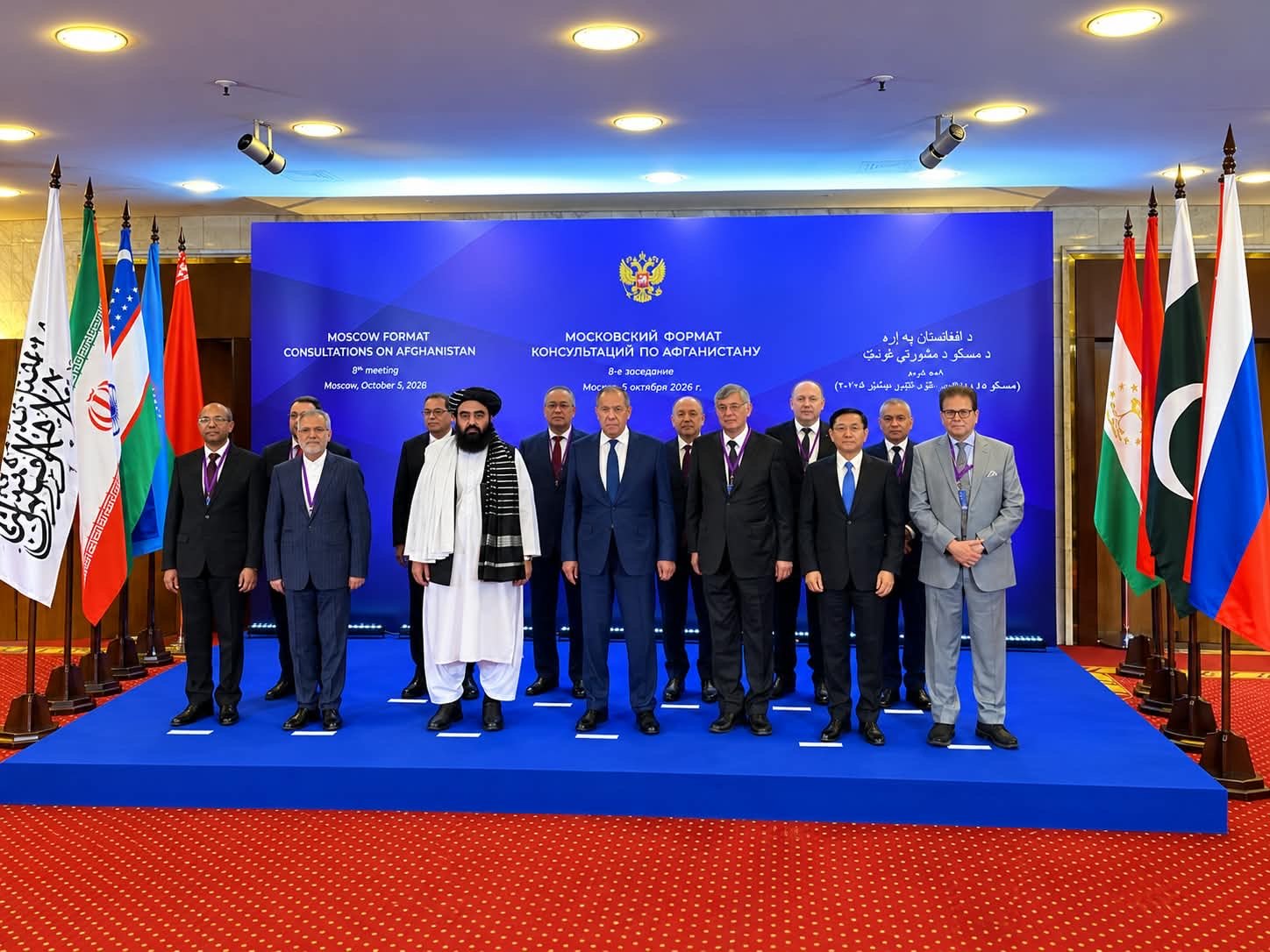
The Taliban blocked counterterrorism language at the Moscow Format that they had signed a year earlier, on the same day Russia praised their record against terrorism.
What Happened In Moscow
The eighth round of the Moscow Format Consultations on Afghanistan met on Monday 5 October. Special envoys and senior officials from Afghanistan, China, India, Iran, Kazakhstan, Kyrgyzstan, Pakistan, Russia, Tajikistan and Uzbekistan attended, with Belarus and Egypt as guests. The format is a Russia-led mechanism. Russia launched it in 2017 as a six-country consultation of special representatives, later expanding it to the Central Asian republics and to Taliban representatives in 2018.
Pakistan’s delegation was led by Special Representative for Afghanistan Mohammad Sadiq, with Naeem Iqbal Cheema, Director-General for Afghanistan, Iran and Turkiye, Ambassador to Afghanistan Ubaid-ur-Rehman Nizamani and Ambassador to Russia Faisal Niaz Tirmizi. Amir Khan Muttaqi, the Taliban’s foreign minister, led the Afghan side. India sent Ambassador to Russia Vinay Kumar and Joint Secretary M. Suresh Kumar of the Ministry of External Affairs.
The meeting came four days after Pakistan’s latest airstrikes inside Afghanistan, on 1 October, targeting Kunar and Helmand provinces. Pakistan said it had hit terrorist hideouts; Kabul said civilians were killed. A Chinese-mediated process had produced a ceasefire in March 2026, and Pakistan resumed airstrikes in September after nearly three months of relative calm.
Why The Statement Failed
The meeting ended without a joint document. The Express Tribune reported it was the first time since the inaugural meeting that participants failed to issue a joint statement.
Zamir Kabulov, Russia’s presidential envoy for Afghanistan, gave the reason. He said the Afghan delegation objected to the draft because Afghanistan was mentioned too often in a terrorist context, and that this surprised Moscow because the same wording appeared in last year’s text. The Afghans told him bilateral relations had changed and the passage was unacceptable this year.
The wording Kabul accepted in 2025 is on the record. Last year’s statement called for comprehensive measures to eliminate terrorism so that Afghan soil was not used to threaten neighbouring countries. Kabul signed that sentence in October 2025 and vetoed its equivalent in October 2026.
What Lavrov Praised
Sergey Lavrov opened the meeting. He said the Taliban-led government had taken control of Afghanistan’s territory and was governing it “with a fair degree of success”. He said Afghan security forces were fighting Islamic State and other terrorist groups, that hundreds of militants had been eliminated, and that attacks on foreign nationals and diplomatic missions had been prevented. He cited UN estimates that opiate production had fallen by 90 percent since 2022.
He also welcomed Muttaqi by congratulating him on the fifth anniversary of Afghanistan’s liberation from the NATO contingent. In July 2025, Russia became the first country to recognise the Taliban government, after removing the group from its list of outlawed organisations.
The praise named one group. Islamic State Khorasan is the Afghan-based affiliate behind the deadliest attack on Russian soil in two decades. At Crocus City Hall in March 2024, RFE/RL reported the death toll rose to 143; Islamic State claimed the attack, and Western intelligence and experts blamed IS-K. Lavrov’s speech did not credit the Taliban with action against the Tehreek-e-Taliban Pakistan, the Baloch Liberation Army or al-Qaeda.
What The UN Record Says
The UN Security Council’s Analytical Support and Sanctions Monitoring Team reports to a Council on which Russia holds a permanent seat. Its February 2026 report, as reported by The News, found that Afghan authorities’ claims that no terrorist organisations operate in the country were not accepted by any Security Council member state, and that the TTP enjoyed greater freedom of movement and facilitation inside Afghanistan, directly contributing to more attacks on Pakistan.
The same report placed al-Qaeda’s regional leadership in the capital. Afghanistan International reported that al-Qaeda in the Indian Subcontinent’s leader, Osama Mehmood, and his deputy, Atif Yahya Ghouri, are present in Kabul.
The team’s most recent report covers 16 December 2025 to 9 June 2026. It found that the Taliban’s continued support for the TTP had contributed to a rise in the frequency and lethality of attacks in Pakistan, even as Kabul took some initial steps to rein in the group. On 28 April, al-Qaeda’s As-Sahab media outlet issued a statement backing the TTP’s operations against Pakistan for the first time.
The Playbook’s Strategic Assessment Paper, The Kabul Assurances, tested eleven Taliban commitments from August 2021 against this record. The central pledge, that Afghan soil would not be used against any country, is the one the Moscow draft restated and Kabul rejected.
Two Threat Maps
The Playbook assesses that Moscow and Islamabad graded the Taliban against different threats. Russia’s concerns are Islamic State Khorasan, narcotics flows into Central Asia, and a return of Western military infrastructure. On each, Lavrov reported progress or reiterated Moscow’s position. Pakistan’s concerns are the TTP, the BLA and al-Qaeda’s support for both. On those, the forum produced no agreed language.
Sadiq set out the second map. He named the TTP, BLA, ETIM, ISKP, al-Qaeda and their affiliates as operating from Afghan soil, and said more than 4,700 Pakistanis had been killed in terrorism over the last three years in attacks Islamabad says originated from Afghanistan. He told the meeting “The Taliban regime is complicit in this,” and called for “concrete and verifiable actions” against terrorist groups.
Muttaqi’s position was the inverse. He accused Pakistan of relying on military pressure rather than diplomacy and said Kabul would set its domestic and foreign policies independently.
The room’s collective position landed on the strikes. According to TASS, Kabulov said all parties called on both sides to refrain from military action against one another and offered to help find political and diplomatic solutions. India’s embassy restated support for Afghan sovereignty, unity and territorial integrity.
Bottom Line
Russia, the first state to recognise the Taliban, praised Kabul’s record against the threats that reach Russia. The Taliban then vetoed counterterrorism language they had accepted a year earlier, and the forum dissolved without a statement. The UN Monitoring Team’s findings on Taliban support for the TTP and al-Qaeda were not reflected in anything the forum produced. A regional format built to align Afghanistan’s neighbours could not agree a single sentence on the threat that has killed the most people across the border. Any future regional arrangement on Afghanistan would need a shared definition of compliance before it could measure one.
Unresolved
The Russian Foreign Ministry transcript of Lavrov’s remarks was not reachable at time of writing, and Pakistani and Indian outlets render his central phrase differently. The draft joint statement has not been published. The positions of China, Iran and the Central Asian delegations on the disputed terrorism passage have not been reported, nor whether any delegation supported Pakistan’s language. Casualty accounts of the 1 October strikes diverge between Islamabad and Kabul. The 4,700 figure is a Pakistani government figure and its methodology has not been published.
What To Watch
The Monitoring Team’s next report, expected in the first quarter of 2027, will show whether the “initial steps” against the TTP held. Watch whether Russia issues a chair’s summary in place of a joint statement, whether Beijing revives the mediation track that produced the March ceasefire, and whether Russian military-technical cooperation with Kabul is formalised. The ninth Moscow round will show whether the 2025 language returns or the 2026 silence becomes the baseline. The Playbook will continue to report on the Kabul Assurances against the public record as it develops. ■