
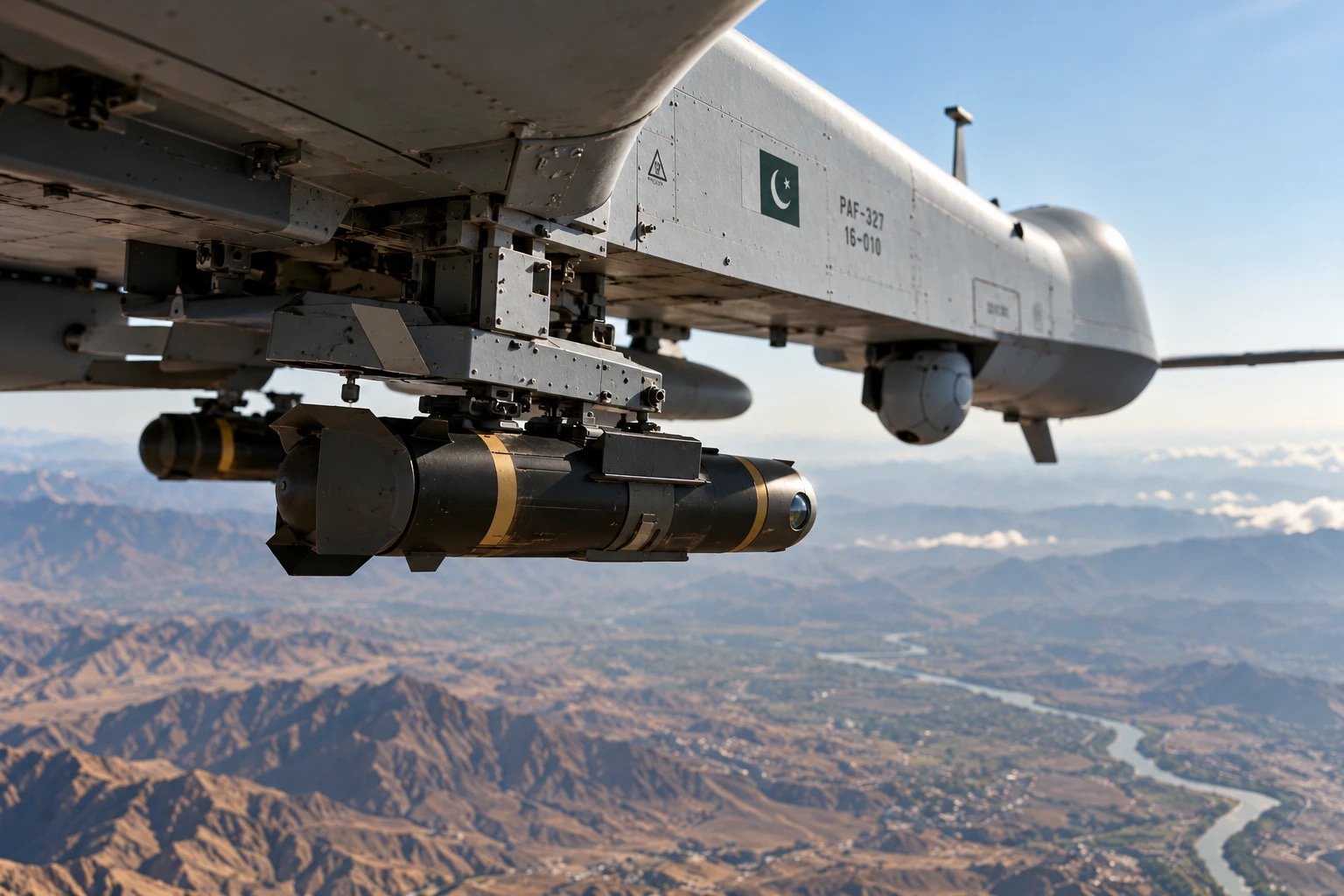
Iran has launched Shahed-136 one-way attack drones at US bases and oil infrastructure across the Gulf since 28 February. Each one costs about $20,000 to produce. The UAE’s Defence Ministry reports that just over 90 per cent of the hundreds of Shaheds fired at it have been intercepted. Kelly Grieco of the Stimson Center calculated that for every $1 Iran spent building a Shahed, the UAE spent about $20 to $28 shooting it down.
Those figures are the backdrop to the latest episode of Playbook Live. The guest is Squadron Leader (Retd) Fahad ibne Masood, a former Pakistan Air Force Mirage pilot, flying instructor and aviation safety specialist.
Masood separates capability from air power. “A cheap drone gives you access to capability,” he said. “It does not give you complete air power. You still need intelligence, communications, command and control, logistics, as well as trained people.” He cited the Dowding System, which helped the Royal Air Force win the Battle of Britain by linking radar stations, observers and operations rooms into one network. In his view, defence against drones depends on the same kind of integration, with any single aircraft or weapon only one part of the whole.
The Paradox Of Simplicity
The Shahed is slow, loud and built from commercial components. Masood said those traits are part of the problem. “The paradox is that simplicity can create defensive difficulty,” he said. “The challenge is not necessarily the sophistication of the individual drone. It is the combination of low cost, low altitude, numbers, and short warning time.” A drone flying low with small radar and thermal signatures gives defenders seconds rather than minutes, and attacks from several directions at night shorten that window further.
Masood set aside the straight comparison of drone price against interceptor price. “The defender is not necessarily trying to match the attacker’s price. It is protecting something more valuable than the interceptor,” he said. The questions a commander should ask, he said, are these: “What am I protecting? What is the threat worth? What response is appropriate? And even more importantly, can I sustain that response for days or weeks?”
Sustaining that response is where defenders run short. Lockheed Martin produced approximately 600 PAC-3 interceptors in 2025. Masood set that figure against drones fielded in the millions on the Ukrainian front, and said magazine depth and production capacity decide how long any air defence network can hold.
The Human In The Loop
Masood spent much of his career in human factors and aviation safety, and he applies that lens to operators facing saturation attacks. “The problem is not simply that there are too many targets. It is that humans must still decide which targets matter most, which are real threats, which weapons should engage, and when to engage,” he said. “Technology does not remove human decision making. It changes where humans make decisions and how quickly they have to make them.”
Automation, he said, should “reduce cognitive burden” rather than “simply give operators more information, because they will get into a TMI or ‘too much information’ state.” Drawing on aviation safety management systems, he argued that no single barrier can carry the load. Defence starts with detecting a threat early and telling a real one from a decoy. The response then has to be proportionate, with scarce interceptors kept for the targets that justify them.
Learning As Combat Power
Ukraine has tested this model under fire for four years. The Ukrainian group Wild Hornets says its interceptor drones can be produced for as little as $1,400 apiece and now achieve a 90 per cent effectiveness rate, up from roughly 70 per cent, as pilots and radar teams gained experience.
Masood credited the gain to organisation as much as hardware. “Learning speed becomes combat power,” he said. “The important capability is therefore not simply the interceptor drone; it is the complete organization’s ability to identify the problem, experiment rapidly, capture feedback, and turn that feedback into a deployable capability.” He warned against buying counter-drone systems as one-off purchases. “Counter-UAS cannot be treated as a procurement project,” he said. “It has to become a continuous adaptation cycle.”
Airbases And Sortie Generation
Drones can ground an air force without hitting a single aircraft. Masood said repeated strikes on runways, radars and fuel depots are enough to halt sortie generation. Airbases need active defence, he said, backed by hardened shelters, redundant facilities and crews who can repair a runway within hours.
The systems the Pakistan Air Force has shown this year are aimed at that problem. Footage published by the PAF on 7 September showed the Chinese HQ-17AE short-range surface-to-air missile system and the Turkish firm Aselsan’s Şahin counter-drone weapon and Korkut self-propelled anti-aircraft gun in operation for the first time. Defence Security Asia assessed the combination as an effort to harden vulnerable airbases, with Korkut’s guns reaching approximately four kilometres and the HQ-17AE engaging aircraft at around 15 kilometres.
Pakistani industry is supplying the innermost layer. Heavy Industries Taxila revealed its P-905 interceptor drone counter-UAS system on 23 July, pairing the OR-503 radar with the I-402 interceptor drone. At a media tour of its new drone factory on 6 September, HIT showed that the system had entered production.
For a country with Pakistan’s budget, Masood proposed a three-part approach. Mature technology should be imported where time matters most. Co-production keeps an industrial base alive. The core of the network, from sensors and data links to the software that binds them, should be built at home.
A Second Front In The West
The May 2025 conflict with India involved state-on-state threats arriving at varying altitudes across a wide front. The western border poses a separate challenge. Information Minister Attaullah Tarar said Pakistan conducted precision aerial and drone strikes against 10 locations in Afghanistan used for launching and storing drones, after drones launched from Afghan territory entered Pakistani airspace on 23 September. Masood said attribution and the need for persistent surveillance define the problem on that front.
The Fighter’s Place
Ukraine has sent F-16s after Shahed-type drones, a front-line fighter chasing a target worth a fraction of its price. Masood asked a different question. “Aircraft value comes from the mission they perform, not simply the price of the target they engage,” he said. “I would not ask, ‘Can this fighter destroy the drone?’ The better question and relevant question is, ‘Is the fighter the most appropriate asset for this particular target?’”
He expects the manned fighter to survive as a high-end command node inside a networked force. “The sky will not be owned by one aircraft or one weapon,” Masood said. “It will be contested by networks or system of systems, and the advantage will come from the force that can sense, decide, act, adapt, and regenerate capability faster.”
Bottom Line
Cheap drones have lowered the price of delivering effects from the air. The Gulf’s interception record shows that high success rates still carry a rising bill, with interceptor production and magazine depth setting the limit. Masood’s case rests on integrated, layered defence. Operators must be shielded from information overload, and the side that learns fastest holds the advantage. The HQ-17AE, Korkut and Şahin systems the PAF revealed in 2026, together with Heavy Industries Taxila’s P-905, point to a layered architecture built around airbase defence.
What To Watch
The Pakistan Air Force has not disclosed quantities or deployment locations for the HQ-17AE, Korkut and Şahin systems; further disclosure would show how far the layered architecture extends beyond point defence. The pace at which the P-905 moves from production into service will test Pakistan’s capacity for the rapid adaptation cycle Masood describes. Lockheed Martin’s PAC-3 output against continued Iranian drone launches will show whether interceptor supply can keep pace in the Gulf. On the western border, further drone incursions from Afghan territory would confirm a persistent second front. The Pakistan Playbook will continue to report on Pakistan’s air defence acquisitions and the drone threat on both its borders. ■