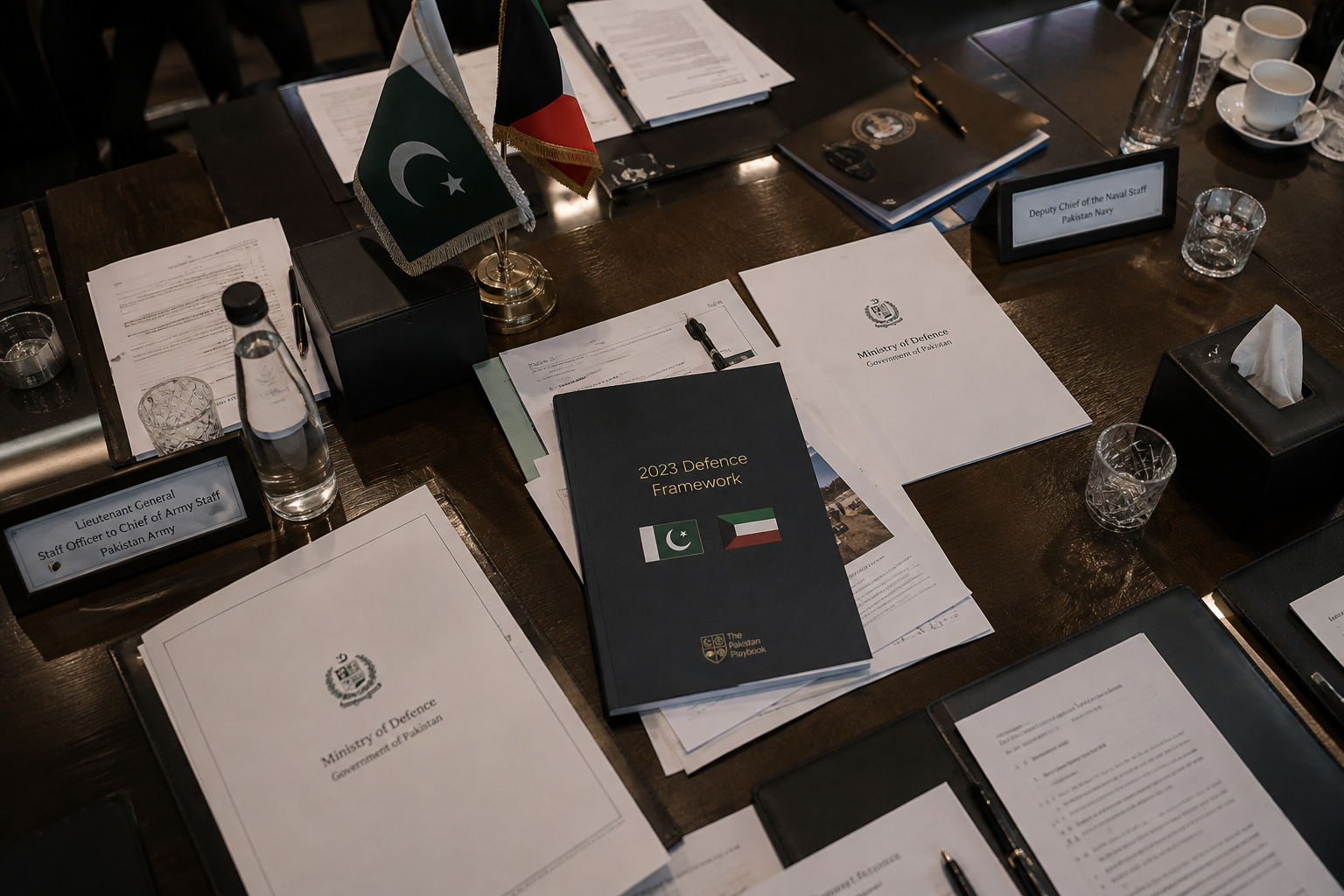
The new instrument covers training, capacity building and border management, and carries no collective defence clause.
Pakistan and Kuwait signed the Protocol Agreement-2026 in Islamabad on 27 August, expanding the military cooperation framework established under the Defence Cooperation Agreement of 2023.
Defence Minister Khawaja Muhammad Asif signed for Pakistan. Kuwait's Minister of Defence, Sheikh Abdullah Ali Abdullah Al-Saleem Al-Sabah, signed for Kuwait while leading a high-level delegation to Islamabad. The delegation also met Field Marshal Asim Munir, Chief of Defence Forces.
Under the protocol, the Pakistan Armed Forces will provide assistance to the Kuwaiti Armed Forces in training, capacity building, border management and other areas to be agreed between the two sides, according to a statement issued by Pakistan's Ministry of Defence.
The protocol follows Kuwait's ratification of the underlying 2023 agreement. That agreement was signed at Kuwait's Ministry of Defence on 11 June 2023 and remained unratified for three years. Kuwait approved it through decree-law number 73 of 2026, published in the official gazette Kuwait Al-Youm on 26 July.
The 2023 Framework
The 2023 framework covers military training and education, joint exercises, intelligence sharing and logistics. It extends to defence technology, military manufacturing, electronic communications systems and scientific research. The agreement runs for five years with automatic renewal unless either party withdraws. A joint military committee headed by representatives appointed by the two defence ministers oversees implementation through annual executive protocols. The Protocol Agreement-2026 is the first such instrument signed since ratification.
No Mutual Defence Obligation
The agreement contains no mutual defence obligation. Neither party is committed to defending the other, and the framework provides for no troop deployments. It sits outside the collective defence architecture Pakistan has built over the past twelve months, which comprises the Strategic Mutual Defence Agreement signed with Saudi Arabia at Al-Yamamah Palace on 17 September 2025, and the trilateral Mecca Joint Defence Agreement signed with Saudi Arabia and Turkey at Al-Safa Palace on 7 August 2026. Both instruments commit their signatories to treat an armed attack on one as an attack on all. The Kuwait framework carries no equivalent clause.
Diplomatic Context
Kuwaiti Foreign Minister Sheikh Jarrah Jaber Al-Ahmad Al-Sabah visited Islamabad in late July, days after ratification, in the first visit by a Kuwaiti foreign minister to Pakistan in more than five years. He met Prime Minister Shehbaz Sharif, Deputy Prime Minister and Foreign Minister Ishaq Dar, and Field Marshal Munir. Dar described the ratification as a milestone for institutional linkages between the two armed forces.
Analysts cited by TRT World assess that the framework's most consequential elements will be joint exercises, intelligence sharing, counter-drone cooperation, maritime security and defence-industrial collaboration. The same assessment records that provisions covering classified information and jointly generated intellectual property indicate a framework designed to accommodate sensitive technological and intelligence cooperation.
Assessment
Pakistan has moved from a ratified framework agreement with Kuwait to a signed implementing protocol in the space of one month, twenty days after signing a trilateral collective defence treaty in Mecca. The Kuwait arrangement sits at a lower tier than either the Saudi bilateral or the Mecca trilateral. Kuwait has not sought accession to the latter, which President Erdoğan has publicly described as open to other countries.
Open Questions
Four questions are unresolved. The scope and location of the border management assistance has not been specified. The financial terms of the protocol, including whether Kuwait will fund Pakistani training deployments, have not been published. Neither government has indicated whether the protocol involves stationing Pakistani personnel in Kuwait. It is unclear whether the annual executive protocol mechanism will produce further instruments before the 2023 agreement's five-year term expires in 2028.
The Pakistan Playbook will continue reporting on the implementation of the Pakistan-Kuwait defence framework as further protocols are signed. ■