Pakistan knows exactly what needs fixing. The question is who is willing to lose power to do it.
Dan Qayyum, for The Pakistan Playbook
Last week the interior minister, Mohsin Naqvi, stood in front of a room full of the people who run Pakistan and told them the system had collapsed. Speaking at the Pakistan Economic Summit in Islamabad on 30 July, he said the present arrangement could not deliver, that the country needed new provinces and real local government, and that every political party should sit in one room, for a day or a month or a year, until they had settled how Pakistan is actually to be governed. He said it plainly and he meant it.
The Diagnosis Is Not New
Naqvi is the newest voice in a very old chorus. Nearly six years ago, in December 2020, Mosharraf Zaidi laid out the same argument in this country's press, and did it more completely. He wrote that Pakistan's governance rested on three contested pillars, parliamentary democracy, federalism and pluralism, and that the failure of federalism was corrosive in a specific way. When federalism fails, he wrote, it "increases the distance between the Pakistani citizen and the Pakistani state. This distance is the cancer that converts peripheral angst into anti-state and separatist sentiment. It is oxygen for the enemies of Pakistan." The diagnosis was right then and has aged into greater accuracy since.
In 2006 Bhutto and Sharif signed a charter promising local bodies autonomy and constitutional protection. That same year a commission chaired by Ishrat Husain, steered by the President, the Prime Minister and all four chief ministers, began two years of work on how to restructure the tiers of government. In 2010 the eighteenth amendment wrote the remedy into the Constitution, Article 140A obliging every province to establish local government and hand it political, administrative and financial authority. In 2012 the Punjab Assembly, treasury and opposition reading out the same text one after the other, demanded new provinces and a federal commission to create them. The National Assembly had done the same the week before. In March 2020 a Chief Justice of Pakistan observed from the bench that Article 140A was being mocked.
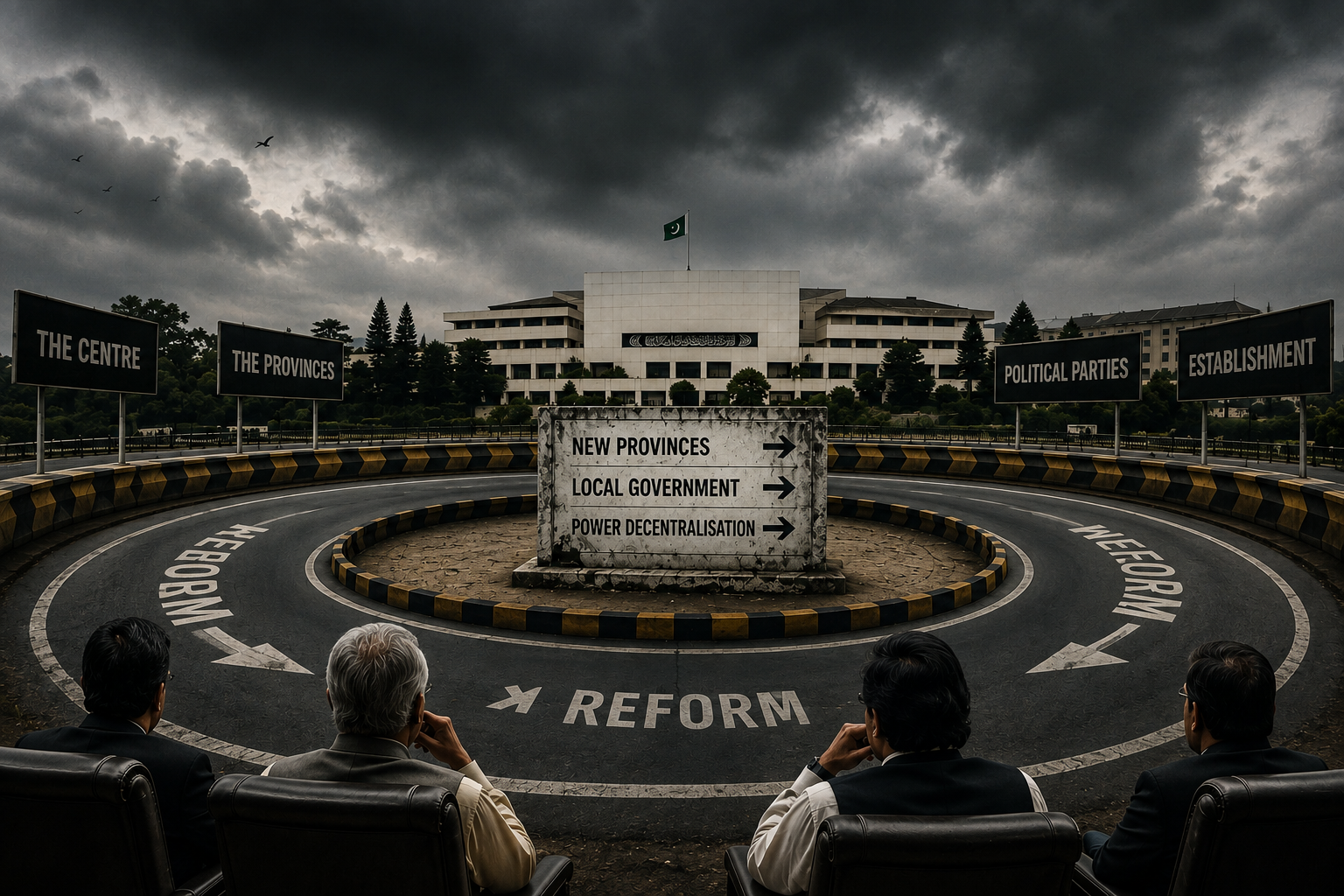
There is no shortage in Pakistan of people who can tell you exactly what is wrong and exactly what would fix it. The country is fluent in its own diagnosis. Which is what makes Naqvi's speech so hard to read. Every government announces that it has turned a corner. Pakistan has turned so many corners, by its leaders' own accounting, that a citizen could be forgiven for noticing the same scenery keeps coming back around. The same problems are named, the same solutions proposed, the same nodding follows, and then nothing moves. The words are not the change. The words are what happens instead of it.
So the useful question is not whether Naqvi is right. He is. The useful question is how anyone outside the room is meant to tell a real turn from another lap. There are ways to tell, if you know what to watch.
Watch for Someone Spending Power They Cannot Get Back
Talk is free, which is why there is so much of it. The remedies on the table all work by moving power away from whoever holds it now, downward to towns and outward to provinces. Someone has to lose for that to happen, and the way to read the moment is to watch how the current holders behave when the demand turns concrete.
The clearest live example is sitting in Sindh. MQM has demanded a separate province around Karachi for decades, and in July it revived the campaign again, with Mustafa Kamal saying the city generates more than half of Pakistan's revenue and has had a fraction of it returned, and that the party would take the fight from parliament to the street. The Pakistan Peoples Party governs Sindh and would lose the most from any redrawing, and its answer was immediate: the Sindh Assembly passed a resolution rejecting any move to carve Karachi out, reaffirming the city as an integral part of the province. Both positions are entirely rational. Both sides are defending their own. And that is precisely why nothing moves, because everyone in the room is protecting the thing the reform would take from them.
So the first real sign of a turn is the inverse of that standoff. It is the first player who gives something up before being forced to. The PPP conceding ground on Sindh's boundaries. A party surrendering a seat advantage it could have kept. The centre releasing a lever it was under no obligation to release. Until someone pays a price they did not have to pay, it is still conversation.
Watch for Whether the Plan Survives Contact
It is easy to agree to reform in a summit hall over tea. The test comes when the reform reaches the institution that has to shrink for it to work. The eighteenth amendment was meant to be exactly this transfer, power and money pushed down to the provinces, and for sixteen years the instinct to claw it back has never rested. That is the honest indicator. Not whether reform is announced, but whether it is still the same reform once it begins costing the powerful, or whether it quietly narrows to the parts that cost no one. Pakistan has a long record of grand agreements whittled, in implementation, down to whatever was painless.
Watch for Whether It Outlasts the Reason It Was Said
Naqvi's speech arrived days before the fifth of August, the anniversary of Imran Khan's imprisonment, a date his party had built a mobilisation around. A call for reconciliation with that timing has a convenient birthday, and much of the country heard the timing before it heard the message. The test is October. If the same urgency survives when there is no protest to defuse and no anniversary to manage, it was real. If it fades with the news cycle that produced it, it was theatre.
Everyone Wants the Destination
Underneath all three tests is a single fact. The diagnosis has been known for years, and the remedy has been known for years, which means the missing ingredient was never knowledge. It was will, and one particular kind, the willingness to lose something. Every actor in the system would prefer a better country in general, and none will pay for it in particular. Imran Khan wanted the system fixed while he held office and did not spend his term dismantling the parts that favoured him. Nawaz Sharif and Shehbaz Sharif have wanted it fixed across three governments and left the centre's grip roughly where they found it. Asif Ali Zardari and Bilawal Bhutto Zardari have wanted it fixed and guarded Sindh's arrangements with equal care. That is two decades, compressed. Everyone wants the destination. No one will spend the fare.
So there is only one indicator that finally counts, and it is not a speech or a summit or a committee. It is sacrifice. The day someone with power gives up something real, without being cornered into it, the corner will have been turned. Nobody will need it explained. Until then the country will keep hearing that it has turned a corner, keep seeing the same scenery come around, and it has long since learned to tell the two apart by feel.
Naqvi has said a true thing. So did the men before him, in the same city, to rooms much like that one. The map has not changed since 1970. ■
Dan Qayyum is a writer, media strategist, and long-standing advisor to government institutions and media organizations across the region. His work explores the intersections of geopolitics, military doctrine, and regional transformation. His upcoming book, The Other Side of Endurance, examines his own journey through crisis, resilience, and reinvention.