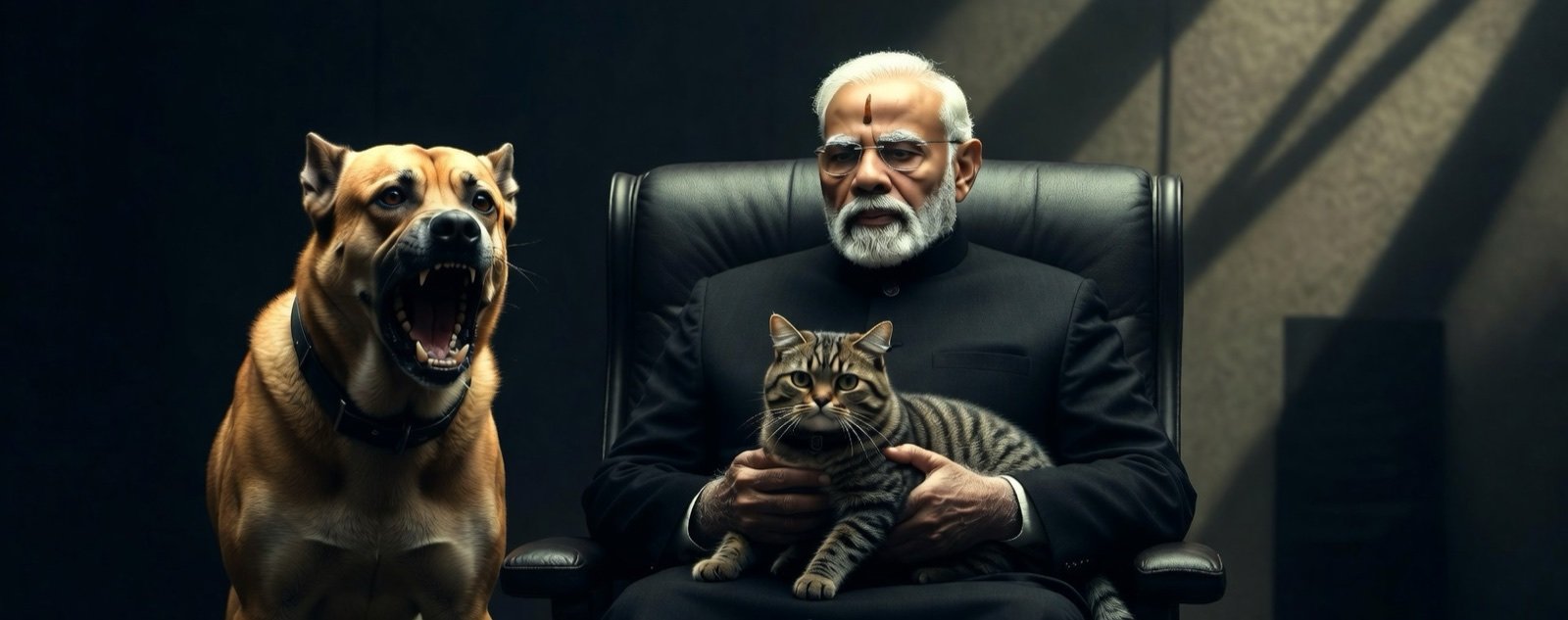
The playbook is consistent. Attack the reviewer. Dismiss the institution. Mobilise the mob. Repeat.
When @TheEconomist published its review of Dhurandhar: The Revenge this week, it did not mince language. Critics, the magazine noted, gave the first film a 35 percent approval rating and the second 43 percent, describing both as "undisguised propaganda, not for the government or even the ruling party but for Narendra Modi himself." The response from India's BJP-aligned commentariat was immediate and entirely predictable. @AdityaRajKaul among the most prominent pro-BJP media voices and a 'research consultant' credited on both films, dismissed the criticism as a Western agenda. Supporters flooded social media with accusations of colonial bias. The Economist's analysis was reframed not as a critical assessment of a film but as an attack on India itself.
This is the playbook. It has been running for a decade.
The Film as Political Infrastructure
Dhurandhar and its sequel did not emerge from nowhere. They are the latest in a sustained wave of films carrying nationalist messaging that has accelerated since Modi came to power in 2014, a lineage that includes Uri: The Surgical Strike, Article 370, The Kashmir Files, The Kerala Story, and Bastar: The Naxal Story. What distinguishes Dhurandhar from its predecessors is the directness of its political content. None of the earlier films champion the Modi government or parrot BJP's ideological stance as forcefully as director @AdityaDharFilms does here.
The film portrays demonetisation as a covert masterstroke that destroyed Pakistan's currency terrorism network overnight, a characterisation contradicted by the Reserve Bank of India's own data showing a 37 percent surge in counterfeit 500-rupee notes in 2024-25. A fictional character named Atif Ahmed, whose physical appearance, criminal history and political journey bear resemblance to late Samajwadi Party-linked politician Atiq Ahmed, procures AK-47 rifles through Pakistan's ISI. The opposition is literally armed by Pakistan. Muslims are among the film's named enemies, alongside Sikh separatists, NGOs and lefties.
The Economist's most pointed observation was that the film's genius lay in reflecting the world many Indians, browbeaten by years of shrill pro-Modi messaging on TV news and social media, already believe to be real. That is not a description of cinema. It is a description of a propaganda ecosystem. The film is downstream of the ecosystem, not its cause.
Both Dhurandhar 1 and Dhurandhar 2 were banned across all six GCC nations, the UAE, Saudi Arabia, Qatar, Kuwait, Oman and Bahrain, over their perceived anti-Pakistan messaging, with distributors across the region confirming that neither film received clearance for screening. The foreign distributor estimated Dhurandhar 1 alone lost $10 million in Gulf earnings. Dhurandhar 2 was projected to lose $15 to 20 million. The ban signals something beyond routine censorship: certification boards explicitly cited the films' anti-Pakistan content and sensitive geopolitical themes, arguing the content could disrupt social equilibrium among the large South Asian diaspora.
India's Film Critics Guild condemned coordinated abuse, personal attacks on individual critics, and organised attempts to discredit their professional integrity after negative reviews provoked mob responses. A review by The Hollywood Reporter India's YouTube channel, by critic Anupama Chopra, was taken down after outrage from fans of the film. @VishalDadlani took to social media urging people to seek accurate information about demonetisation, an indirect rebuke of the film's central political claim. Actor @divyaspandana posting as Ramya, called it "a masterclass in how to turn something promising into an endurance test." @prakashraaj, the veteran south Indian actor, looked at the southern film stars who lined up to praise Dhurandhar 2 and posted: "Signs of obligation are spreading south too." The mob did not need instructions. It knew what to do.
How Bollywood Was Leashed
The transformation of Bollywood from an industry capable of producing morally complex, politically inconvenient cinema into what critics call a compliance machine did not happen overnight. It happened through social media mob pressure, government regulatory threats, and the simple commercial logic that films perceived as anti-nationalist face organised boycott campaigns capable of destroying box office returns.
The clearest illustration of what the alternative looks like is @anuragkashyap72 who for three decades was one of Indian cinema's most significant directors, Gangs of Wasseypur, Ugly, Sacred Games. He landed deals with Netflix after the platform entered India in 2016, promising to produce edgy Hindi-language content. But in 2021, Netflix shelved what would have been his magnum opus: an adaptation of Maximum City, exploring Hindu bigotry and the extremes of hope and despair in Mumbai.
The reason was not creative disagreement. Prime Video shelved a satirical series called Gormint because it mocked Indian politics. Netflix relinquished the rights to a documentary exploring the 1975-1977 Emergency period because it contained veiled commentary about the Modi administration. Netflix and Amazon, faced with losing access to a billion-person market, chose compliance over editorial independence. Reliance Jio's compliance team internally documented how staff evaluated content by putting "the company's relationship with the government in perspective" before greenlighting anything.
Kashyap's path to exile from commercial Indian cinema began in 2019 when he spoke at anti-government protests over the Citizenship Amendment Act. He called the government fascist on Twitter. He flew to Delhi to stand with students attacked by masked mobs. The BJP's spokesperson filed a police complaint against him, alleging his Netflix series Sacred Games had intentionally insulted Sikh religious feelings. The RSS held meetings with Netflix and Amazon executives to restrict "anti-Hindu and anti-national" content.
Kashyap's 2023 film Kennedy premiered at Cannes to a standing ovation and did not receive a wide Indian release for years. In January 2023, when Modi finally told BJP leaders to stop making unnecessary comments about films, Kashyap's response was blunt: "The mob is out of control now. Things have gone out of hand." He was right that it was too late. He was also right about who let it loose.
The Khans: A Study in Incentives
The contrast between how the state treats compliant and critical voices in the film industry is most visible in how it has treated Bollywood's three biggest Muslim stars over the past decade.
Shah Rukh Khan (@iamsrk) is the most documented case. In 2015, shortly after Modi came to power, he said there was a climate of intolerance that "will take us to the dark ages." Within days, Yogi Adityanath, now chief minister of Uttar Pradesh and a senior BJP figure, compared Khan to Hafiz Saeed, the UN-designated terrorist considered the mastermind of the 2008 Mumbai attacks, and threatened that he would be out of business if Hindus boycotted his films. In October 2021, the Narcotics Control Bureau, a central agency under Modi's government, raided a cruise ship and arrested SRK's son Aryan Khan. No drugs were found on Aryan personally. The NCB's case rested primarily on WhatsApp chats, and the raid had been tipped off by Manish Bhanushali, a BJP functionary who was present at the operation as an "independent witness." Aryan spent 28 days in custody before being granted bail, despite leading legal experts pointing out there was no evidence against him. In May 2022 the NCB gave him a clean chit entirely, dropping all charges for lack of sufficient evidence. The NCB's own lead officer, Sameer Wankhede, subsequently faced a CBI investigation and allegations of demanding a Rs 25 crore bribe from SRK to drop the case. Multiple analysts drew an explicit connection between the arrest of SRK's son and the actor's refusal to align with the BJP government. The Diplomat was direct: "The arrest of his son seems aimed at bringing to heel the Bollywood superstar, a Muslim, for not aligning with the BJP government."
Salman Khan's case is structurally different but thematically adjacent. His decades-long blackbuck poaching case saw him convicted to five years in prison by a Jodhpur trial court in 2018, a case that has wound through an extraordinary 27-year sequence of convictions, acquittals and reversals, with the Rajasthan High Court only scheduling the next hearing in 2025. Khan has since been photographed flying kites with Modi, attended government functions, and positioned himself firmly within the cultural establishment. The legal clouds have not cleared in any formal sense. They have simply stopped producing rain.
No one has proven a direct transaction in either case. But the pattern, legal pressure coinciding with political distance, legal quietude coinciding with political proximity, repeats with sufficient frequency that it has its own Indian-language term in the commentary: the "setting" of compliance.
The International Verdict
The international media record on India's press freedom and cultural suppression is not the work of anti-India conspiracists. It is a consistent body of documented evidence from institutions that have no particular interest in hostility toward New Delhi.
Reporters Without Borders (@RSF_en) ranked India 159th out of 180 countries on its 2024 Press Freedom Index, behind Turkey, Pakistan and Sri Lanka, describing India's media as being in an "unofficial state of emergency" since 2014.
Mukesh Ambani's Reliance Industries, a personal ally of Modi's, owns more than 70 media outlets followed by at least 800 million Indians. The term for the resulting journalism, Godi media, meaning lapdog media, a play on Modi's name, was coined not by foreign critics but by Indians watching their own television screens.
CNN documented how a study of prime-time television tracking more than 400 segments found that 52 percent of airtime was spent criticising the opposition, while another 27 percent pushed pro-Modi narratives.
The Reuters Institute for the Study of Journalism documented Modi's crackdown on the foreign press, noting that thirty foreign correspondents from the Financial Times, the Washington Post, France 24, the Guardian, the New York Times and the Wall Street Journal signed an open letter protesting the treatment of journalists denied work permits. French journalist Vanessa Dougnac, based in Delhi for 23 years and married to an Indian national, received a notice from the Ministry of Home Affairs stating her journalistic activities were "malicious" and "critical in a manner that they create a biased negative perception about India." She was denied a journalistic permit without explanation.
The BBC produced a two-part documentary examining Modi's role during the 2002 Gujarat riots. The Indian government blocked videos and links sharing the documentary, calling it "hostile propaganda and anti-India garbage" with a "colonial mindset." The BBC's India offices were then raided under tax investigation laws. Freedom House documented the BJP's use of government institutions to target political opponents and the harassment of journalists, civil society organisations and other government critics, noting this had increased significantly under Modi.
As recently as March 10, 2026, cartoonist Satish Acharya (@satishacharya) disclosed that X withheld two of his cartoons depicting India-Iran relations. One showed Modi blindfolded alongside a body labelled "Killed by USA and Israel." Instagram and Facebook content deleted in response to Indian government orders for the first six months of 2025 was up 300 percent compared to the same period in 2023.
Germany-based YouTuber Dhruv Rathee (@dhruv_rathee), with tens of millions of Indian subscribers, criticised Dhurandhar 2 as functioning as a BJP advertisement. The response was coordinated trolling, accusations of being foreign-funded, and a campaign to discredit his entire body of work. The pattern was identical to what was deployed against the BBC, against Kashyap, against every Indian or international voice that has applied critical scrutiny to the Modi government's record.
The Siege Mentality as Policy
What makes the BJP's response to international criticism structurally interesting is that it serves a domestic function that has nothing to do with actually refuting the criticism. Every time The Economist, the BBC, the Washington Post or Human Rights Watch publishes findings critical of India under Modi, the government and its allied media machinery mobilise around a single narrative: that India is under siege from hostile foreign forces working with domestic anti-nationals to undermine the nation.
The criticism becomes the proof of conspiracy. The more credible the source, the more dangerous the enemy. RSF's ranking is a Pakistani plot. The BBC has a colonial agenda. The New York Times carries a hidden agenda. Anurag Kashyap is foreign-funded. Dhruv Rathee is a traitor operating from abroad. SRK's son was a drug criminal. Aryan Khan was given a clean chit. Nobody remembers. The arrest did its job.
The siege framing has a precise political utility. It positions every critical Indian voice as a collaborator with foreign hostility, making dissent not merely wrong but treasonous. It gives the mob its script. And it ensures that the space for legitimate internal critique shrinks with each cycle, because the cost of speaking is not just trolling but the credible threat of UAPA charges, tax raids, permit denials, a son arrested on a cruise ship, and the quiet disappearance of professional opportunities.
When the world's leading media institutions, press freedom organisations, and human rights bodies converge on the same conclusion about a country's direction, the country faces a choice. It can engage with the criticism, examine the evidence, and reckon honestly with what it has become. Or it can build a taller wall, produce another film, mobilise another mob, and tell itself that the world simply does not understand.
India, under Modi, has consistently chosen the wall. Dhurandhar 2 just made it a few hundred crore rupees taller.
Originally published on X by @DanQayyum — read the original post →